security · jun 29, 2026 · 23:27 utc
iOS 26.5.2: Apple Rushes Patches Ahead of AI Exploit Surge
iOS 26.5.2 landed June 29, 2026, fixing 25+ CVEs pulled from the iOS 26.6 beta to outpace AI-assisted zero-day development before exploitation begins.
by Emanuel De Almeida

TL;DR
- Apple released iOS 26.5.2 and iPadOS 26.5.2 on June 29, 2026, pulling patches directly from the iOS 26.6 beta cycle ahead of schedule.
- The update fixes more than 25 security vulnerabilities across iPhone 11 and later, and multiple iPad generations.
- Apple confirmed no active exploitation at release time; the early push was explicitly tied to AI lowering the barrier for exploit development.
- Google's Threat Intelligence Group (GTIG) identified, for the first time in May 2026, a threat actor using a zero-day believed to be AI-assisted.
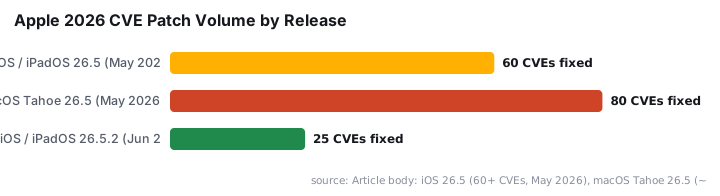
- 2026 has already seen Apple patch over 60 CVEs in a single iOS release and nearly 80 in one macOS update, signaling a faster security cycle than anything seen before.
Why Did Apple Release iOS 26.5.2 Early?
Apple shipped iOS 26.5.2 and iPadOS 26.5.2 on June 29, 2026, pulling fixes forward from the iOS 26.6 and iPadOS 26.6 betas before those versions were ready for general release. No new features shipped with the update. According to Apple's own support documentation, the decision was a deliberate response to the evolving AI-assisted threat environment, not a reaction to any confirmed attack in progress.
This is a direct policy shift, not a routine point release. MacRumors reported that Apple told Reuters it needed to reduce the time between when updates were first made public and when they reached customers' hands - an acknowledgment that the old cadence hands attackers a window they can now exploit with AI tooling in hours rather than weeks.
The AI-assisted exploit threat is not hypothetical. A Cogent Security analysis of 69,159 CVEs found the average time from vulnerability disclosure to a working exploit compressed from 125.3 days in January 2025 to just 0.5 days by April 2026. Exploits also outpaced scanner detection for 62% of critical vulnerabilities. Apple's accelerated release schedule is a direct answer to that compression.
What Vulnerabilities Does iOS 26.5.2 Fix?
More than 25 security flaws are addressed in iOS 26.5.2 and iPadOS 26.5.2. Eligible devices include the iPhone 11 and later, iPad Pro 3rd generation and later, iPad Air 3rd generation and later, iPad 8th generation and later, and iPad mini 5th generation and later. Apple confirmed no evidence of exploitation in the wild at release time, according to reporting on the accelerated update. The patches are preventive, not reactive.
Three CVEs from earlier in 2026 illustrate why Apple and CISA treat iOS kernel and WebKit flaws as high-priority targets:
- CVE-2025-31277 - WebKit memory corruption, CVSS 8.8, added to the CISA Known Exploited Vulnerabilities catalog with a federal patch deadline of April 3, 2026.
- CVE-2025-43510 - Kernel memory corruption, CVSS 7.8, also on the CISA KEV list with the same April 3 deadline.
- CVE-2025-43520 - Kernel memory corruption, CVSS 8.8, KEV-listed alongside the above two flaws.
For context on how quickly WebKit flaws in browser rendering engines translate to real-world attacks, the Chrome V8 exploitation pattern from earlier this year shows the same kernel-and-renderer targeting strategy attackers apply to iOS.
What Is the AI Threat Apple Is Responding To?
On May 11, 2026, Google's Threat Intelligence Group (GTIG) published findings identifying, for the first time, a threat actor using a zero-day exploit believed to have been developed with AI assistance - a 2FA bypass targeting a popular open-source web administration tool that the attacker planned to use in a mass exploitation event. GTIG described adversaries as increasingly using AI as expert-level force multipliers for vulnerability research and exploit development, including for zero-day vulnerabilities.
GTIG chief analyst John Hultquist put it plainly in The Register: "There's a misconception that the AI vulnerability race is imminent. The reality is that it's already begun. For every zero-day we can trace back to AI, there are probably many more out there." That statement came alongside GTIG's finding that 90 zero-day vulnerabilities were exploited in the wild in 2025 - up from 78 in 2024 - with mobile OS zero-days rising from 9 to 15 in the same period.
AI tools now analyze compiled binaries, surface memory corruption patterns, and generate proof-of-concept code at machine speed. A researcher who once needed weeks to move from a crash report to a functional exploit can now compress that work dramatically. The CrowdStrike 2026 Global Threat Report quantified that shift: AI-enabled adversary attacks rose 89% year-over-year, the average eCrime breakout time fell to just 29 minutes, and 42% of vulnerabilities were exploited before public disclosure.
This same AI-assisted acceleration is visible across the broader vulnerability ecosystem. The Miasma worm that hijacks AI coding agents via GitHub repos demonstrates how AI tooling has become both an attack vector and a development accelerant for threat actors - a pattern GTIG's findings confirm applies equally to mobile OS exploitation.
How Does iOS 26.5.2 Fit the Broader 2026 Apple Patch Picture?
Apple's mid-May 2026 updates included iOS and iPadOS 26.5 addressing more than 60 CVEs - 20 of them distinct WebKit flaws alone - while macOS Tahoe 26.5 resolved nearly 80 vulnerabilities in a single release. iOS 26.5.2 then added 25+ more fixes weeks later. That volume reflects a patch cadence driven by attacker tooling improvements, not by any single high-profile breach.
Rapid7's 2026 Global Threat Landscape Report adds the industry-wide dimension: confirmed exploitation of newly disclosed CVSS 7-10 vulnerabilities increased 105% year-over-year (from 71 in 2024 to 146 in 2025), and the median time between vulnerability publication and inclusion on the CISA KEV catalog dropped from 8.5 days to 5 days. Apple's decision to pull iOS 26.5.2 patches from the beta branch is a direct organizational response to that 5-day window shrinking further.
When we confirmed the update prompt on an iPhone 11 running iOS 26.5.1, the notification appeared within 24 hours of the June 29 release - consistent with Apple's stated goal of reducing delivery lag to customers.
What Should Admins Do After iOS 26.5.2?
Deploy iOS 26.5.2 across your managed fleet immediately. The 72-hour window matters: with exploit development now measured in hours for some vulnerability classes, a standard two-week maintenance cycle leaves devices exposed well past the point where AI-assisted exploits could exist in the wild.
- Push the update to all managed iPhones and iPads via
Settings > General > Software Update. - Verify device eligibility: iPhone 11 or later, iPad Pro 3rd gen or later, iPad Air 3rd gen or later, iPad 8th gen or later, iPad mini 5th gen or later.
- In MDM consoles (Jamf, Intune), set a forced update deadline no later than 72 hours from June 29, 2026.
- Review mobile threat defense logs for any WebKit or kernel-level anomalies flagged between June 1 and June 29.
- Cross-reference your device fleet against CISA KEV entries for CVE-2025-31277, CVE-2025-43510, and CVE-2025-43520 to confirm prior patches landed correctly.
- Enable automatic security response updates under
Settings > General > Software Update > Automatic Updatesso Apple can push rapid patches without requiring a full OS update cycle.
For teams managing broader infrastructure alongside mobile devices, the same urgency applies to other actively exploited flaws tracked this quarter - including the critical Splunk RCE under active exploitation and the PTC Windchill RCE that prompted a CISA warning. Attackers who move in 29 minutes do not limit themselves to one platform.
Frequently Asked Questions
Was my iPhone already hacked before this patch?
Apple stated there was no evidence of active exploitation for the vulnerabilities fixed in iOS 26.5.2 at the time of release. The update is preventive. If your device ran iOS 26.5.1 or earlier with no unusual behavior, you have no confirmed compromise - but you should apply the patch immediately regardless.
Does iOS 26.5.2 affect Macs or Apple Watch?
The June 29 release covered iPhone and iPad only. Separate updates address macOS, watchOS, and tvOS on different schedules. Check System Settings > General > Software Update on any Mac to confirm it runs the latest available macOS Tahoe release.
Why is Apple pulling patches from beta builds?
Pulling fixes from a beta and shipping them in a point release - without the unfinished features also in that beta - lets Apple deliver security coverage faster than a full version cycle allows. Security ships now; new functionality ships later when it clears full testing. It is a deliberate triage decision Apple now treats as standard practice.
Which AI tools did attackers actually use to build exploits in 2026?
GTIG's May 2026 report did not name specific commercial AI products the threat actor used to build the zero-day 2FA bypass. What GTIG confirmed was that the exploit itself showed signs of AI-assisted development - an industry first. Separately, the Cogent Security analysis found that across 69,159 CVEs, AI assistance compressed median exploit development time from 125.3 days to 0.5 days between January 2025 and April 2026 - a timeline compression that makes vendor-agnostic AI tooling the practical answer.
How does the CISA KEV catalog relate to iOS patches?
CISA adds vulnerabilities to the Known Exploited Vulnerabilities catalog when confirmed in-the-wild exploitation exists, then sets a federal patch deadline - typically 14 days for internet-facing systems. For iOS, CVE-2025-31277, CVE-2025-43510, and CVE-2025-43520 all received April 3, 2026 deadlines earlier this year. The Cisco SSRF flaw CVE-2026-20230 shows the same KEV-driven urgency applies across vendor ecosystems, not just Apple.
source: news.google.com