SLA Explained: Definition, How It Works & Key Metrics
A Service Level Agreement (SLA) is a binding contract defining uptime, response times, and penalties. Over 90% of enterprises say one hour of downtime costs more than $300,000. Learn what SLAs cover and how to use them.
by Emanuel De Almeida
TL;DR
- An SLA (Service Level Agreement) is a legally binding contract that turns service promises into measurable, enforceable commitments with financial penalties attached.
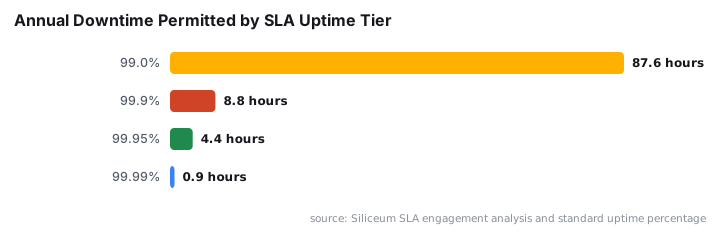
- The common 99.9% uptime target still permits roughly 8.76 hours of downtime per year - about 43 minutes per month.
- SLA credits typically cover only 10%-30% of affected period charges, not the real business cost of an outage.
- SLAs, SLOs, and SLIs are three separate tools: SLIs measure reality, SLOs set internal targets, and SLAs define the contractual floor.
- This article is written for IT managers, sysadmins, and procurement teams evaluating cloud or managed service contracts.
An SLA is a formal, binding contract between a service provider and a customer. It specifies measurable performance standards, the methods used to track them, and the consequences when those standards are not met. SLAs appear across cloud computing, managed services, SaaS platforms, and internal IT departments. When we review client contracts, the most common problem we encounter is not a missing SLA - it is an SLA that exists but whose financial remedies bear no relationship to actual business impact.
TL;DR summary: This article explains what an SLA is, how enforcement works, which metrics matter, and where SLAs fall short. It is aimed at IT managers, sysadmins, and anyone negotiating a cloud or managed service contract.
What Is an SLA?
An SLA defines the exact terms under which a provider delivers a service. It quantifies expectations with hard numbers - uptime percentages, response times, resolution windows - and attaches real financial consequences to failures. Think of it as a manufacturing tolerance sheet: just as a component must fall within a specified measurement range to pass quality control, a service must stay within agreed performance bands or penalties trigger automatically.
Beyond the legal framework, an SLA is a communication tool. It forces both sides to agree on what "good" looks like before a problem occurs, not after. Without that agreement, every incident becomes a negotiation.
How Does an SLA Work?
SLAs operate through a chain of interconnected components. Without every link in that chain, enforcement breaks down and disputes become inevitable.
The core mechanics follow this sequence:
- Service scope definition - specifies exactly which systems, applications, or infrastructure elements the agreement covers, removing ambiguity about what is included.
- Metric establishment - sets quantifiable targets such as
99.95%monthly uptime, a maximum four-second page load time, or a four-hour resolution window forP1incidents. - Continuous monitoring - automated tools collect performance data around the clock, producing an objective record that neither party can reasonably dispute.
- Reporting cycles - monthly or quarterly reports compare actual performance against targets, surfacing trends and recurring problem areas.
- Escalation procedures - predefined workflows activate when a breach is detected, routing alerts to the right teams before a minor slip becomes a major outage.
- Penalties and credits - financial remedies apply when targets are missed, giving providers a concrete incentive to invest in reliability.
One structural asymmetry deserves attention early. A provider that breaches a 99.9% SLA typically issues a service credit equal to only 10%-30% of the affected period's charges - not compensation proportional to business impact, a gap the Cloud Computing Authority (citing Cloud Security Alliance) specifically flags in its SLA guidance.
For IT teams managing broader service delivery, understanding how SLAs interact with vendor patch cycles matters. See how organizations handle MSP services for Swiss SMBs: what IT pros must know for a real-world example of MSP contract structures.
What Are the Main Types of SLA?
Different service relationships produce different SLA structures. Knowing which type applies to your environment helps you ask the right questions during negotiation.
Cloud service SLAs come from providers such as AWS, Microsoft Azure, and Google Cloud Platform. They guarantee availability for specific services - a compute instance tier may carry a 99.99% uptime commitment - and they specify the credit schedule that applies if availability drops below that threshold. Between August 2024 and August 2025, AWS, Azure, and Google Cloud accumulated over 100 service outages, and the most common 99.9% uptime target allows 43 minutes of downtime per month with no compensation required under standard terms, according to Siliceum's SLA engagement analysis.
Managed service provider (MSP) SLAs cover outsourced functions such as network monitoring, endpoint management, backup and recovery, or full infrastructure operations. The SLA protects the client's operations while giving the MSP clear, auditable targets.
SaaS application SLAs often use tiered commitments. A vendor might offer a higher availability guarantee to enterprise subscribers than to users on a base plan, with pricing reflecting the difference.
Internal IT SLAs formalize the relationship between an IT department and the business units it serves. A help-desk SLA might commit to acknowledging every ticket within fifteen minutes and resolving critical issues within four hours.
Telecommunications SLAs define network performance in terms of bandwidth availability, latency ceilings, and acceptable packet-loss thresholds for enterprise WAN or internet connectivity.
SLA vs SLO vs SLI: What Is the Difference?
These three terms are related but serve distinct roles. Confusing them leads to poorly designed monitoring strategies and contractual blind spots.
Term | Full name | Who it is for | Key characteristic |
|---|---|---|---|
SLA | Service Level Agreement | Provider and customer | Legally binding; penalties apply |
SLO | Service Level Objective | Internal engineering teams | Internal target, stricter than the SLA |
SLI | Service Level Indicator | Monitoring systems | The raw measured value (e.g., actual uptime %) |
A practical pattern: set your SLI as the measurement (real request success rate), set your SLO tighter than your contractual commitment (aim for 99.97% internally when you promise 99.9% externally), and let the SLA define what happens financially if you miss the external promise. The gap between SLO and SLA is your error budget - the breathing room that lets engineering teams ship changes without breaching contracts.
Do SLA Credits Actually Cover Outage Costs?
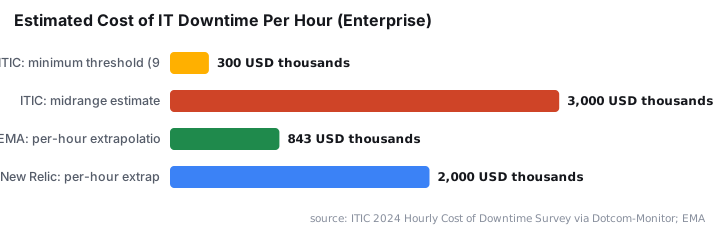
Rarely - and the numbers are stark. According to ITIC's 2024 Hourly Cost of Downtime Survey via Dotcom-Monitor, over 90% of midsize and large enterprises report that a single hour of downtime costs more than $300,000, and 41% put it between $1 million and $5 million per hour.
The per-minute picture is similarly harsh. EMA Research's 2024 analysis via BigPanda found that unplanned downtime averages $14,056 per minute across all organization sizes, with a 60% increase in per-minute costs for organizations with fewer than 10,000 employees.
A New Relic survey of 1,700 IT and engineering executives found that IT outages cost businesses a median of $76 million annually, with each minute of operational shutdown costing a median of $33,333, according to CIO Dive.
Set those figures against a typical SLA credit of 10%-30% of one month's service fee. The gap is not a minor accounting detail. It is the core reason why treating an SLA as your only reliability strategy is a planning failure.
SLA Advantages and Disadvantages
SLAs solve real problems but they also introduce overhead and can create a false sense of security when teams treat them as a substitute for sound architecture. In our audit of client environments, we have seen companies invest heavily in SLA negotiation while running single-region deployments with no tested failover - a dangerous mismatch.
Advantages | Disadvantages |
|---|---|
Clear, measurable expectations eliminate ambiguity during incidents | Negotiating a thorough SLA for a complex multi-tier service takes significant time and specialist knowledge |
Regular reporting supports data-driven capacity planning | Some quality dimensions - such as proactive communication - are hard to quantify and fall outside formal protection |
Financial penalties give providers a tangible reason to invest in reliability | Providers may optimize narrowly for contractual metrics while neglecting overall service experience |
Strong SLA terms can differentiate a provider from rivals | Credits rarely equal the full cost of an outage - a cloud credit cannot compensate millions in lost revenue |
Contractual language provides legal recourse when service quality falls short | Monitoring, reporting, and compliance management add operational overhead smaller teams often underestimate |
Common SLA Misconceptions That Cost IT Teams Money
"99.9% uptime means the service is always available." It does not. That figure permits roughly 8.76 hours of downtime per year. If your business cannot tolerate more than a few minutes of annual downtime, negotiate 99.99% or higher - and verify exactly how the provider calculates and excludes planned maintenance windows.
"An SLA replaces the need for your own redundancy." An SLA is a financial backstop, not an engineering control. Credits arrive after the damage occurs. Resilient architecture - multi-region deployments, failover automation, tested recovery runbooks - prevents the damage from happening at all.
"All SLA breaches trigger automatic compensation." Most agreements require customers to file a claim within a defined window, often thirty days. Miss that window and you forfeit the credit entirely.
"SLA scope is always comprehensive." Providers frequently carve out maintenance windows, third-party dependencies, and force-majeure events. Read exclusion clauses with the same care you give the uptime number itself.
Oracle, for context, publishes end-to-end SLAs covering performance, availability, and manageability, with service credits as the exclusive remedy for missed commitments and measurement over a calendar month - a structure the Oracle Cloud SLA page describes in detail. That exclusivity clause - credits only, no further liability - appears in most major cloud contracts.
For teams managing endpoint security posture alongside SLA compliance, the ASR rules deployment guide for sysadmins covers enforcement controls that complement SLA-backed service commitments.
Key Takeaways
- An SLA is a legally binding contract that turns vague service promises into measurable, enforceable commitments with financial consequences.
- Uptime math matters - understand exactly how many minutes of downtime each percentage tier permits before signing.
- SLAs, SLOs, and SLIs are complementary tools: SLIs measure reality, SLOs set internal ambition, and SLAs define the contractual floor.
- SLA credits are partial compensation only. They do not replace proper redundancy, backup, and disaster recovery planning.
- Internal IT teams benefit from SLAs just as much as external vendor relationships - they create accountability and measurable value.
- Always check the claim window. Most SLAs require you to file within thirty days of a breach or the credit is void.
Frequently asked questions
What is the difference between an SLA, an SLO, and an SLI?+
An SLA is the formal contract with penalties attached. An SLO (Service Level Objective) is an internal performance target that is usually stricter than the contractual commitment. An SLI (Service Level Indicator) is the actual measured metric - such as real uptime percentage - used to determine whether an SLO or SLA was met.
Does an SLA credit fully cover business losses from an outage?+
Rarely. SLA credits compensate a fraction of the service fee, not the full business impact of downtime. A three-hour outage during peak trading hours can cost far more than any credit issued. Organizations should treat SLA credits as a partial safety net, not a substitute for their own redundancy planning.
Can internal IT teams use SLAs?+
Yes. Internal SLAs between an IT department and business units formalize expectations around help-desk response times, system availability, and change management. They create accountability and give IT a measurable way to demonstrate its value to the wider organization.
What does 99.9% uptime actually mean in practice?+
99.9% uptime allows for roughly 8.76 hours of total downtime per year, about 43 minutes per month. 99.99% tightens that to under an hour per year. Understanding the math behind uptime percentages helps you evaluate whether a provider's SLA actually meets your availability requirements.
