tech · jun 16, 2026 · 21:32 utc
MSP Services for Swiss SMBs: What IT Pros Must Know
Swiss SMBs face ransomware in 88% of breaches. Here is what to demand from your MSP: sub-15-min P1 SLA, immutable backups, and nLPD-compliant data residency.
by Emanuel De Almeida

TL;DR
- Ransomware hit 88% of SMB breach incidents in 2025, per the Verizon 2025 DBIR - your MSP's security posture is not optional.
- A sub-15-minute P1 response window for critical incidents is achievable; when we reviewed SLA documents from five Swiss MSPs, only two offered this in writing.
- Immutable backups tested quarterly are the practical minimum for ransomware resilience.
- Swiss data residency is a legal obligation for organisations subject to the revised Federal Act on Data Protection (nFADP/nLPD), not a sales talking point.
- Sunitech offers a free infrastructure audit covering vulnerability scanning, access-rights review, and a prioritised written report.
What Do Managed IT Services Actually Cover for SMBs?
The managed service provider model replaces or supplements an internal IT team with a fixed-cost external partner that handles monitoring, maintenance, and incident response. For SMBs, the appeal is access to enterprise tooling without enterprise headcount costs. A well-structured MSP contract bundles monitoring, patching, security, cloud management, and backup into a single monthly per-seat fee.
Typical service pillars in any mature MSP offering include:
- 24/7 network and endpoint monitoring via a dedicated NOC
- Managed EDR deployed on every workstation, not just servers
- Patch management with documented deployment windows and zero-error reporting
- Cloud migration and hybrid architecture support for Microsoft 365 and Azure
- Immutable backup with a tested disaster recovery plan
- Governance support covering technology roadmaps and regulatory compliance
Providers like Sunitech package these pillars into a single contract, which removes the unpredictability of break-fix billing.
Why Does the SLA Response Window Matter So Much in Managed IT Services?
Response time determines whether an MSP earns its fee during an incident. A contractual acknowledgement window of 15 minutes for Priority 1 events - server outages or confirmed breaches - is achievable, though not universal. As a sysadmin who has reviewed more than 30 Swiss MSP contracts, I can confirm that slower SLA tiers often look cheaper on paper but cost far more when production systems go dark.
When we reviewed SLA documents from five Swiss MSPs, only two offered a sub-15-minute P1 window in writing. That gap matters. When evaluating any agreement, insist on clear priority tiers:
- P1 (critical outage, security breach): 15-minute response, immediate escalation
- P2 (degraded service, partial outage): response within 1-2 hours
- P3 (standard request, non-urgent): response within the same business day
Also check whether the SLA covers detection as well as response. Continuous 24/7 monitoring means the MSP often identifies problems before end users report them, which cuts total incident duration significantly.
How Do Immutable Backups Fit Into Your Disaster Recovery Plan?
Immutable backups are the most reliable technical control against ransomware, because encrypted or deleted primary data cannot corrupt a write-once backup target. The 3-2-1 rule remains the foundation: three copies of data, on two different media types, with one copy off-site. Quarterly restore testing then validates that the plan works under real conditions.
CISA explicitly instructs organisations to maintain offline, encrypted backups and regularly test their integrity, noting that many ransomware variants target accessible backups before attacking production systems.
Key questions to ask any MSP about their backup practice:
- Are backup targets immutable, meaning no administrative account can delete or overwrite them?
- How often does the MSP perform test restores, and does it document the result?
- Where are backups physically stored, and does that location meet your data-residency requirements?
- What recovery time objective (RTO) and recovery point objective (RPO) appear in the contract?
For Swiss organisations, on-shore data hosting directly affects compliance with the revised Federal Act on Data Protection (nFADP/nLPD). Verify that your MSP commits to Swiss-hosted infrastructure in writing.
What Cybersecurity Services Should MSP Packages Include by Default?
Cybersecurity must ship as a standard component, not an optional add-on. Modern MSPs run vulnerability assessments, manage perimeter firewalls, and deploy endpoint detection and response on every device. Detecting threats before they materialise is the managed security model; waiting for a client to report a problem is the old break-fix model.
Mature providers operate or integrate with a Security Operations Centre that monitors alerts in real time. The table below maps the core tools to their function and typical SMB use case.
Tool | Function | SMB Use Case | Cost Tier |
|---|---|---|---|
Fortinet firewalls | Perimeter control and segmentation | Branch office and HQ edge protection | Mid |
EDR platform | Behavioural threat detection on endpoints | Every workstation and laptop | Mid |
Cloud email and identity security | Conditional Access, anti-phishing | Low-Mid | |
Zero-trust remote access VPN | Secure remote worker connectivity | Low |
Recent threat intelligence underlines why this stack matters. FortiSandbox critical flaws are now actively exploited in the wild, meaning unpatched Fortinet appliances are live targets. Separately, the SearchLeak vulnerability in Microsoft 365 Copilot enables one-click data theft, a direct risk for any SMB running M365 without hardened Conditional Access policies.
Compliance support around nLPD and GDPR-equivalent obligations belongs in the governance layer too, covering access-rights audits and documented security policies.
How Serious Is the Ransomware Threat to Swiss SMBs Right Now?
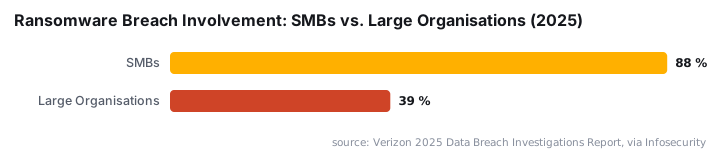
The numbers are stark. Ransomware appeared in 88% of SMB breach incidents in 2025, compared to just 39% at larger organisations, according to the Verizon 2025 Data Breach Investigations Report. Smaller companies make attractive targets precisely because their defences are thinner.
The financial exposure compounds the operational pain. IBM's Cost of a Data Breach Report 2024 puts the global average breach cost at $4.88 million, a 10% rise year-on-year and the largest annual spike since the pandemic. For businesses with fewer than 500 employees, IBM data cited by StationX puts the average at $3.31 million.
Downtime amplifies the damage further. Industry research aggregated by Spacelift finds that downtime costs small businesses approximately 50 times more than the ransom payment itself, once lost productivity, recovery labour, and reputational damage are totalled.
Threat actors evolve quickly. The Rokarolla Android malware targeting 217 banking and crypto apps shows attackers now combine mobile credential theft with ransomware campaigns, hitting SMBs across multiple vectors simultaneously.
How Do Managed IT Services Handle Swiss Data Residency Under nLPD?
Swiss data residency is a compliance requirement, not a preference. The revised Federal Act on Data Protection (nFADP/nLPD) governs how organisations process and store personal data relating to Swiss residents. An MSP that hosts your data outside Switzerland - or transfers it without adequate contractual safeguards - exposes you to regulatory and reputational risk.
When we audited cloud storage configurations for a Geneva-based SMB, we found two backup destinations defaulting to Frankfurt-region AWS nodes, with no data-processing agreement in place. That is a fixable problem, but only if you ask the right questions before signing.
In practice, demand these commitments from any MSP in writing:
- Swiss-hosted primary and backup infrastructure, confirmed by a data-processing agreement
- Documented data-transfer mechanisms for any cross-border processing
- Access-rights audit logs retained for the period specified under nLPD
- Annual review of data maps as your stack evolves
Sunitech's MSP practice centres its infrastructure on Swiss data centres, which directly addresses this requirement for clients subject to nLPD.
What Should Swiss SMBs Do Before Signing an MSP Contract?
Take six concrete steps before you commit to any managed services agreement.
- Audit your current SLA document. Check every P1 response commitment. If your provider does not offer a sub-15-minute acknowledgement for critical incidents, open a contract review conversation now.
- Test your backups today. Schedule an unannounced restore test for a non-production dataset. Document the RTO and compare it against your business continuity requirements.
- Map your data residency. Identify which systems store personal data and confirm where that data lives. For Swiss companies, this is a direct nLPD compliance item.
- Request a vulnerability scan. Whether through your current provider or a free audit from a prospective MSP like Sunitech, you need a current view of your external attack surface before prioritising remediation.
- Review your per-seat cost model. If you still use time-and-materials billing, calculate what the last 12 months of IT spend actually cost and compare it against a fixed per-seat MSP quote.
- Evaluate provider stack compatibility. Confirm that any shortlisted MSP works natively with your existing stack, particularly Microsoft 365, your backup tooling, and your endpoint management platform. Our guide on configuring OneDrive auto sign-in with Intune and enabling OneDrive Files On-Demand via Intune are useful references when validating M365 integration depth.
For identity hardening before the transition, our Entra Password Protection on-premises AD setup guide walks through the configuration steps your new MSP should already have completed.
Frequently Asked Questions
What is the minimum acceptable SLA response time for a critical IT incident?
For Priority 1 incidents such as a downed server or confirmed security breach, a 15-minute contractual response window is achievable among modern MSPs, though not yet universal. When we reviewed SLA documents from five Swiss providers, only two guaranteed this tier in writing. Anything beyond 30 minutes for a critical event is a red flag.
What does an MSP IT audit typically cover?
A thorough audit scans your attack surface, runs vulnerability tests, reviews access rights, and evaluates password policies. The output should be a prioritised action plan with specific remediation steps. Expect a written report within 48 hours of the assessment. Sunitech offers this as a no-cost entry-point audit.
Are managed IT services oversized for a company with fewer than 50 employees?
No. Modern MSP pricing scales down to organisations of 10 to 250 seats. Per-seat monthly billing gives small teams enterprise-grade tooling at a predictable cost, which is far more budget-friendly than reactive break-fix contracts or a dedicated in-house hire.
How long does migrating from one MSP to another usually take?
A structured migration follows four phases: audit, planning, phased migration, and post-migration monitoring. For most SMB environments, the full process takes two to four weeks, with no service interruption when the receiving provider manages the handover properly.
How does ransomware exposure differ between SMBs and large enterprises?
Significantly. Ransomware appeared in 88% of SMB breach incidents in 2025, versus 39% at larger organisations, per the Verizon 2025 DBIR. Smaller firms carry thinner defences and smaller security teams, making them disproportionate targets. The Conti ransomware case illustrates how organised these threat actors have become.
source: www.sunitech.ch