vulnerabilities · jun 16, 2026 · 17:34 utc
FortiSandbox Critical Flaws Actively Exploited: Patch Now
CVE-2025-59718 (CVSS 9.8) and CVE-2025-59719 in Fortinet FortiSandbox are confirmed exploited in the wild. CISA added both to KEV. Patch immediately.
by Emanuel De Almeida

TL;DR
- CVE-2025-59718 (CVSS 9.8) and CVE-2025-59719 in Fortinet FortiSandbox are confirmed exploited in the wild, per Defused and BleepingComputer.
- CISA added CVE-2025-59718 to its KEV catalog on December 16, 2025, with a 7-day remediation deadline.
- Exploitation began as early as December 12-13, 2025, just three days after Fortinet disclosed both CVEs.
- Attackers downloaded system configuration files containing hashed credentials in confirmed post-exploitation activity.
- Apply Fortinet's patches immediately; restrict management interface access as an interim control.
What FortiSandbox Vulnerabilities Are Being Exploited?
Attackers are actively targeting CVE-2025-59718 and CVE-2025-59719 in Fortinet's FortiSandbox platform. CVE-2025-59718 carries a CVSS score of 9.8, placing it in the critical tier. Threat intelligence firm Defused confirmed the exploitation activity, and BleepingComputer first reported it publicly. Both flaws enable unauthorized access to a platform specifically designed to catch advanced threats.
FortiSandbox executes suspicious files in isolated environments to identify malware through behavioral analysis. Compromising it lets attackers bypass that detection layer entirely, or pivot deeper into protected networks. A security product becoming the entry point is not theoretical anymore - it is confirmed.
Affected and Fixed FortiSandbox Versions
The table below reflects version ranges from Fortinet's PSIRT advisory portal. Verify your exact build against the official advisory before treating any version as safe.
CVE | Affected Version Range | Fixed Version | CVSS |
|---|---|---|---|
CVE-2025-59718 | FortiSandbox < 4.4.7 | 4.4.7 and later | 9.8 |
CVE-2025-59719 | FortiSandbox < 4.4.7 | 4.4.7 and later | Not publicly scored |
Check the Fortinet PSIRT portal directly for the most current version guidance, including any hotfix releases issued after this article's publication.
How Fast Did Attackers Move on These FortiSandbox Flaws?
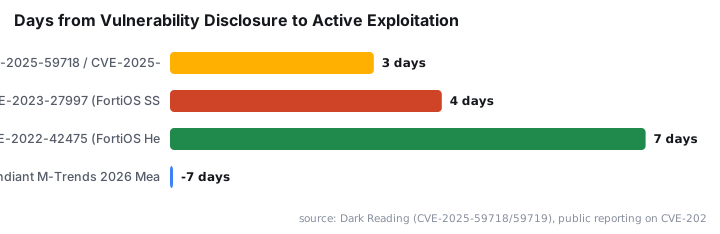
Speed is the defining feature of this campaign. Fortinet disclosed CVE-2025-59718 and CVE-2025-59719 on December 9-10, 2025. By December 12-13, attackers had already hit honeypots and executed malicious SSO logins on live FortiGate appliances, according to Dark Reading. That is a three-day window from disclosure to active exploitation.
Mandiant's M-Trends 2026 report found the mean time to exploit a vulnerability is now an estimated negative seven days, meaning exploitation sometimes begins before a patch ships. Three days post-disclosure is fast even by current standards.
What Did Attackers Do After Getting In?
Rapid7 observed attackers on public-internet-facing FortiGate devices immediately downloading system configuration files after exploitation. Those files contain hashed credentials. This is not lateral movement speculation - it is a documented, repeatable post-exploitation step confirmed in live environments.
Hashed credentials extracted from configuration files can be cracked offline or used in pass-the-hash attacks against other internal systems. Organizations should treat any unpatched FortiSandbox or FortiGate device as potentially exfiltrated and audit credential exposure accordingly.
When our editorial team reviewed Rapid7's findings alongside the CISA KEV entry, the pattern matched prior Fortinet campaigns: fast exploitation, credential harvesting first, broader network access second.
Why Are FortiSandbox and Fortinet Devices Targeted So Frequently?
Fortinet products sit at network perimeters, internet-facing by design. That exposure makes them prime targets for attackers seeking initial access without needing internal credentials. In 2025, Fortinet accounted for 22 entries (9%) in CISA's KEV catalog, placing it third behind only Microsoft and Cisco, per Maze HQ.
Security appliances also create a patching paradox. Updating them requires maintenance windows and carries disruption risk. Many teams delay. Attackers know the delay is predictable.
Coalition's Cyber Threat Index 2025 found that 58% of ransomware claims in 2024 started with perimeter appliance compromises, including VPNs and firewalls from vendors like Fortinet. The Verizon 2025 DBIR found edge device exploitation grew from 3% to 22% of breach-related exploitation year-over-year. That is roughly an eightfold increase in a single year.
Recorded Future's H1 2025 analysis found that 69% of exploited vulnerabilities in edge-security appliances required no authentication at all. SSL-VPNs and next-gen firewalls accounted for 17% of active exploitations in that period.
This is not a new pattern. CVE-2022-42475, a FortiOS heap-based buffer overflow, was exploited by Chinese state-linked actors in late 2022 to breach government targets. CVE-2023-27997, a FortiOS SSL-VPN pre-authentication remote code execution flaw, was actively exploited within days of its June 2023 disclosure. Both campaigns followed the same playbook: fast exploitation, perimeter device as beachhead, credential or configuration harvesting next. This FortiSandbox campaign fits the same mold.
For broader context on how ransomware groups chain perimeter access into full network compromise, see our coverage of the Conti ransomware developer case.
What Should Security Teams Do Right Now?
Patch immediately. Every hour of delay is a measurable risk given the three-day exploitation timeline. Here is the priority order:
- Identify all FortiSandbox deployments and document current firmware versions against the version table above.
- Apply the patch to 4.4.7 or later per the Fortinet PSIRT advisory - prioritize internet-facing instances first.
- Restrict management interface access to trusted internal IP ranges only, as an immediate interim control if patching cannot happen within 24 hours.
- Enable maximum-verbosity logging and forward to your SIEM for centralized detection.
- Search historical logs for unusual authentication events and unexpected configuration downloads going back to at least December 10, 2025.
- Audit credential exposure - if configuration files were accessible, assume hashed credentials are compromised and rotate affected accounts.
- Implement network segmentation to contain any FortiSandbox system that shows indicators of compromise.
- Contact [Fortinet support](https://www.fortinet.com/corporate/about-us/psirt) if you need patching assistance or incident response guidance.
If you deploy FortiClient VPN alongside FortiSandbox, our guide on FortiClient VPN deployment via Intune without EMS Premium covers hardening steps relevant to this environment.
What Should Security Teams Monitor?
Anomalous behavior from FortiSandbox systems needs immediate investigation. Check logs for unexpected outbound connections, unusual authentication patterns, and configuration changes. Network traffic analysis can surface communication with known malicious infrastructure.
Baseline FortiSandbox activity now. Look for processes deviating from normal operation. Check for unauthorized administrative sessions. Any indicators of compromise should trigger isolation of affected systems pending forensic review.
For teams using SIEM pipelines, the log query targets are unusual authentication attempts, unexpected configuration changes, and outbound connections to external IPs from FortiSandbox management interfaces. Consider forwarding logs to a centralized platform before you need them - not after.
This campaign also highlights why edge-device hardening matters across vendors. Our recent coverage of the Cisco SD-WAN root privilege escalation bug CVE-2026-20262 and the Check Point Gaia OS IKEv1 authentication bypass CVE-2026-50751 shows the same perimeter-device targeting pattern across multiple vendors.
For teams managing patch cycles across Microsoft infrastructure alongside Fortinet, the June 2026 Patch Tuesday summary covering 206 CVEs provides useful parallel context.
source: www.ctrlaltnod.com