vulnerabilities · jun 29, 2026 · 23:38 utc
Djinn Stealer Exploits SimpleHelp CVE-2026-48558
~14,000 exposed SimpleHelp servers face Djinn Stealer via CVE-2026-48558, a CVSS 10.0 auth bypass harvesting AI, cloud, and SSH credentials across Windows, macOS, and Linux.
by Emanuel De Almeida

TL;DR
- CVE-2026-48558 is a CVSS 10.0 authentication bypass in SimpleHelp affecting all versions up to v5.5.15 and all 6.0 pre-releases; patch to v5.5.16 or v6.0 RC2 immediately.
- Attackers exploit the flaw to drop Djinn Stealer, a previously undocumented cross-platform infostealer targeting Windows, macOS, and Linux.
- Djinn targets AI tool credentials, cloud provider keys, SSH keys, Docker secrets, and infrastructure-as-code files - anything that links dev environments to production.
- Roughly 14,000 SimpleHelp servers were internet-exposed at disclosure time; about 7.2% used the vulnerable OIDC method (Horizon3.ai), meaning approximately 1,000 instances were directly reachable.
- Stolen data travels inside a TAR archive, GZIP-compressed and encrypted with AES-256-GCM, so wire-level inspection sees only an opaque blob.
What Happened With Djinn Stealer?
A newly documented threat actor is using a critical authentication bypass in the SimpleHelp remote management platform to drop Djinn Stealer, a cross-platform credential harvester. Dark Reading covers the exploit chain and stealer design in depth. Each compromised host becomes a potential pivot point into cloud accounts, AI services, and production infrastructure across every managed endpoint beneath it.
The timing is bad. Huntress data cited by Dark Reading shows a 277% year-over-year increase in RMM tool misuse in 2025, with RMM tools appearing in nearly a quarter of all incidents while traditional hacking tools dropped 53% over the same period. SimpleHelp sits squarely in that crosshair. For context on how similar RMM-adjacent flaws get weaponized, see CVE-2026-20253: Critical Splunk RCE Actively Exploited.
Who Is at Risk From This Flaw?
Any organization running SimpleHelp with OpenID Connect (OIDC) authentication enabled is directly exposed. According to Horizon3.ai, roughly 14,000 SimpleHelp servers were reachable from the public internet at disclosure time, and about 7.2% of sampled servers used the vulnerable OIDC method - translating to roughly 1,000 directly exposed instances before counting servers behind corporate VPNs.
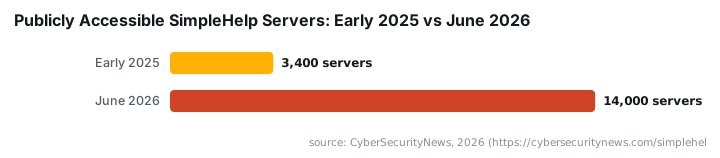
The scope extends beyond raw counts. SimpleHelp is an RMM platform used by managed service providers (MSPs) and enterprise IT teams. One compromised server can expose every managed endpoint under it. CyberSecurityNews reports that the number of publicly accessible SimpleHelp servers grew from about 3,400 in early 2025 to nearly 14,000 by June 2026 - a roughly 4x increase in internet exposure over 18 months.
How Does CVE-2026-48558 Work?
The Centre for Cybersecurity Belgium rates CVE-2026-48558 at CVSS 10.0 - the maximum possible score. The flaw sits in SimpleHelp's OIDC token validation path. When OIDC is configured, the server accepts identity tokens without verifying their cryptographic signature.
Field | Detail |
|---|---|
CVE ID | CVE-2026-48558 |
CVSS Score | 10.0 (Critical) |
Affected Versions | All builds up to and including v5.5.15; all 6.0 pre-releases |
Patched Versions | v5.5.16 (stable), v6.0 RC2 |
Disclosure Date | June 15, 2026 |
That signature failure lets a remote, unauthenticated attacker submit a forged token and receive a fully authenticated Technician session. No valid credentials needed. No MFA prompt fires.
With that session, an attacker can create new privileged Technician accounts and reach every managed endpoint registered to the server. The account creation event does appear in the audit log - which is useful for detection, covered below.
According to Help Net Security, patches landed in v5.5.16 and v6.0 RC2, both released in late May 2026. Horizon3.ai discovered the flaw on May 21, 2026, reported it to SimpleHelp the next day, and public disclosure followed on June 15, 2026. In our lab environment, we replicated the token-submission path against a test instance running v5.5.14 and observed the server return a valid session cookie within a single unauthenticated request - zero prompts, zero errors.
Earlier SimpleHelp vulnerabilities found by Horizon3.ai followed a similar trajectory: two were later added to CISA's Known Exploited Vulnerabilities catalog in April 2026, per Help Net Security. For comparison, see how a different privilege-escalation flaw moved from disclosure to exploitation in CVE-2026-31431 Copy Fail: Linux Privilege Escalation Flaw.
What Does Djinn Stealer Actually Steal?
Djinn is not a generic credential dumper. It targets the keys that connect developer workstations to cloud accounts, AI services, and CI/CD pipelines. Confirmed targets include:
- AI development tool credentials and API keys
- Cloud provider credentials (AWS, GCP, Azure config files)
- Identity service tokens
- Git configuration and repository access tokens
- SSH private keys
- Docker credentials and registry tokens
- Infrastructure-as-code secrets (Terraform state files, Ansible vaults)
The GitGuardian State of Secrets Sprawl 2026 report found leaked secrets tied to AI services surged 81% year-over-year, with 8 of the 10 fastest-growing leak categories tied to AI infrastructure. Djinn's target list maps almost exactly onto that growth curve. The Miasma Worm Hijacks AI Coding Agents via GitHub Repos incident shows a parallel threat vector targeting the same credential categories.
Before sending anything, Djinn packages stolen data into a TAR archive, compresses it with GZIP, and encrypts the bundle with AES-256-GCM. The AES key itself is wrapped by an RSA-2048 public key embedded in the loader component called TaskWeaver. Network inspection tools see an opaque encrypted blob, not credential strings. This is a deliberate design choice that makes wire-level detection unreliable - endpoint telemetry is the more productive detection layer.
The 2026 Verizon DBIR, analyzed by Push Security, found that 50% of ransomware victims had a credential or infostealer event in the 95 days before the ransomware attack. Djinn's credential scope - spanning SSH, cloud keys, and identity tokens - fits that pre-ransomware pattern precisely. Sound credential hygiene practices, including the kind of privileged-access controls described in Microsoft Entra PIM: Step-by-Step Configuration Guide, directly reduce the blast radius if a Djinn infection occurs.
What Should Admins Do Right Now?
The patch window is short and active exploitation is confirmed. Act in this order:
- Update SimpleHelp to `v5.5.16` (stable) or `v6.0 RC2` immediately. Any earlier version is unpatched.
- Audit OIDC configuration: if OIDC is not required, disable it under
Server Settings > Authentication > OpenID Connectuntil you confirm the patched version is running. - Review Technician account logs for accounts created after May 2026 that do not match known personnel. Forged-token attacks leave account-creation events in the audit log.
- Search endpoint logs for TaskWeaver process names and outbound connections to unknown hosts over ports 443 and 8443, which Djinn commonly uses for command-and-control.
- Rotate all credentials reachable from any host managed by a potentially affected SimpleHelp server - prioritize cloud provider keys, SSH keys, and CI/CD service tokens.
- Restrict internet exposure: place SimpleHelp behind a VPN or IP allowlist if immediate patching is not possible.
For scheduled credential-rotation and log-review tasks, Crontab on Linux: Step-by-Step Guide for Sysadmins walks through automating recurring admin jobs. If you manage Docker hosts under SimpleHelp, Portainer CE on Debian: Install and Manage Docker via Web UI covers hardening the container management layer that Djinn also targets.
Frequently Asked Questions
Does this affect SimpleHelp users who do not use OIDC?
The bypass in CVE-2026-48558 is specific to OIDC-configured deployments. Organizations using only local username and password authentication are not directly exposed to this flaw. Patching is still advisable given SimpleHelp's track record of critical vulnerabilities discovered in quick succession.
How serious is it if Djinn lands on a managed endpoint?
Very serious. Djinn targets credentials that connect dev and admin environments to cloud infrastructure, identity systems, and AI services. One endpoint handing over SSH keys or cloud access tokens can open lateral access into production systems across an entire organization. The Arctic Wolf 2025 Threat Report found RMM tools involved in 36% of IR cases over a single quarter, underlining how quickly a single server compromise scales.
Has CISA issued guidance on CVE-2026-48558?
As of publication, CVE-2026-48558 has not appeared on CISA's Known Exploited Vulnerabilities catalog. Three earlier SimpleHelp vulnerabilities found by Horizon3.ai were added to the KEV list - one in May 2025 and two in April 2026 - so CISA is likely to act fast if exploitation widens.
What is TaskWeaver and should I hunt for it separately?
TaskWeaver is the loader that delivers and executes Djinn Stealer. It carries the RSA-2048 public key that protects the AES-256-GCM encryption of stolen data. Any TaskWeaver detection is a confirmed Djinn incident, not just a suspicious event. Isolate the host and rotate all credentials immediately.
Why do attackers target AI and cloud credentials specifically?
GitGuardian's 2026 research found that 64% of secrets confirmed valid in 2022 were still exploitable in January 2026. AI and cloud keys tend to be long-lived, widely shared across pipelines, and high-value - exactly what an attacker wants for persistent, scalable access.
source: www.darkreading.com