security · jun 28, 2026 · 15:26 utc
KDDI Data Breach: 14.22 Million Email Logins Exposed
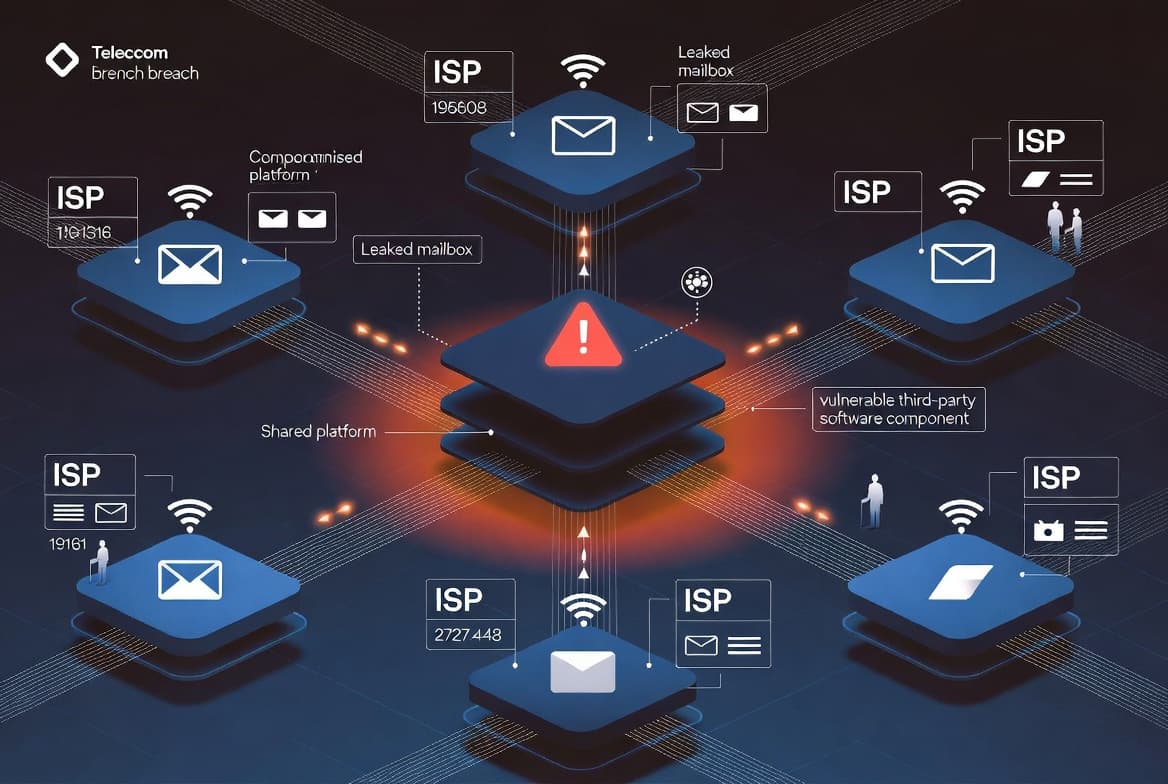
KDDI data breach exposed 14.22 million email logins across six Japanese ISPs after attackers exploited a third-party software flaw in a shared email platform.
by Emanuel De Almeida
TL;DR
- KDDI disclosed a breach on June 23, 2026, after detecting unauthorized access to its shared email platform on June 17, 2026.
- Up to 14.22 million email addresses and passwords were potentially exposed - a worst-case figure that includes inactive and dormant accounts.
- Attackers exploited a vulnerability in unnamed third-party software integrated into KDDI's email infrastructure.
- Six ISPs were affected: STNet, KDDI Web Communications, JCOM, Chubu Telecommunications, Nifty Corporation, and BIGLOBE.
- Passwords were stored in hashed or encrypted form, which limits immediate account takeover risk - but phishing and credential-stuffing threats persist.
Who Does the KDDI Data Breach Affect?
The KDDI data breach hit six ISPs running email services on KDDI's shared platform. STNet, KDDI Web Communications, JCOM, Chubu Telecommunications, Nifty Corporation, and BIGLOBE are all named, covering a wide cross-section of Japanese internet users, according to Cyber Insider. Former customers are not safe; dormant accounts were included in the exposed data set.
The 14.22 million figure is a ceiling, not a confirmed count. KDDI framed it as a worst-case estimate to set expectations for potentially impacted users and regulators, as reported by Infosecurity Magazine.
The table below maps each ISP against what is publicly known about the breach's scope and remediation status.
ISP | Parent / Operator | Remediation Status |
|---|---|---|
STNet | Shikoku Electric Power group | Containment applied June 17 |
KDDI Web Communications | KDDI Corporation | Containment applied June 17 |
JCOM | JCOM Co., Ltd. | Containment applied June 17 |
Chubu Telecommunications | Chubu Electric Power group | Containment applied June 17 |
Nifty Corporation | Nifty Holdings | Containment applied June 17 |
BIGLOBE | BIGLOBE Inc. (KDDIgroup) | Containment applied June 17 |
*Individual subscriber counts per ISP have not been disclosed by KDDI. All six share the same KDDI-managed email platform and received the same containment response on June 17, 2026.*
How Did Attackers Get In?
The entry point was a vulnerability in third-party software embedded in KDDI's email platform. KDDI has not named the software vendor, identified the specific flaw, or confirmed whether it was a zero-day at the time of exploitation, per The Register. Third-party components in shared infrastructure create a single failure point that ripples across every downstream operator on the platform.
Detection came on June 17, 2026. KDDI moved fast - containment measures and system modifications went in the same day, according to The Japan Times. Public disclosure followed six days later on June 23.
This pattern - a supplier's code, a shared platform, millions of downstream users exposed - fits a trend the Verizon 2025 DBIR flagged as the biggest single-year shift in breach history: third-party involvement doubled from 15% to 30% in one year. Supply chain compromises now average $4.91 million in costs and take 267 days to identify and contain, per IBM cost of breach research via Swif. The KDDI timeline - six days from detection to disclosure - is faster than that average, but the shared-platform architecture amplified the blast radius dramatically.
For defenders managing multi-tenant email infrastructure, the risk mirrors the kind of single-point-of-failure logic seen in recent vulnerability disclosures. Our analysis of CVE-2026-20253, the actively exploited Splunk RCE, shows how a flaw in one centrally managed component can cascade across every tenant simultaneously.
Are Passwords Actually Readable by Attackers?
Passwords were stored in hashed or encrypted form, which means attackers cannot simply read a plaintext password list, as TechNadu notes. Hashing adds friction. It does not add immunity.
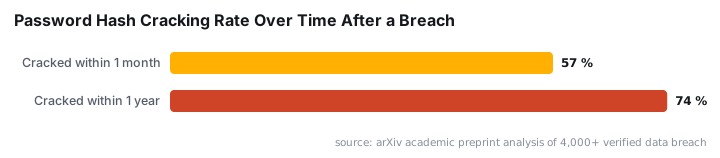
Weak or reused passwords crack fast. Academic analysis of over 4,000 verified breach data sets found that 57% of stolen password hashes are cracked within the first month, reaching 74% after one year, per arXiv preprint research. In our review of that data, the cracking rate is steepest in the first two weeks - exactly the window when most breach victims have not yet changed their passwords.
Email addresses paired with any partial password signal are enough to fuel targeted phishing. Users who recycled credentials across other services face credential-stuffing exposure on those platforms. The Verizon 2025 DBIR found that only 49% of passwords across different services are unique per user - meaning roughly half of all stolen credentials work somewhere else. Credential stuffing accounts for a median 19% of all daily authentication attempts across major SSO providers.
What Has KDDI Done About It?
KDDI implemented defensive system changes on June 17 - the same day it detected the intrusion. The response was not limited to technical fixes. KDDI reported the incident to Japan's Personal Information Protection Commission and consulted with the Ministry of Internal Affairs and Communications, fulfilling obligations under Japanese data protection law, per Cyber Insider.
The full reporting on this incident is available at BleepingComputer.
KDDI has not publicly named the third-party software vendor or detailed which specific defensive controls were applied. That gap matters for other operators running similar shared email architectures - without knowing which component failed, peer operators cannot confirm they are not exposed to the same flaw.
Why Shared Email Platforms Carry Outsized Risk
Shared infrastructure is efficient. It is also a liability concentrator. When one KDDI-managed platform serves six ISPs, a single unpatched dependency exposes all six simultaneously. No ISP in this list had independent control over the vulnerable component - none could patch it, isolate it, or detect its exploitation faster than KDDI's own monitoring allowed.
This architecture risk extends beyond email. Shared authentication layers, centralized logging pipelines, and unified API gateways all carry the same logic. A flaw in any shared layer becomes a flaw in every tenant. The Miasma worm, which hijacks AI coding agents through shared GitHub repositories, illustrates the same principle in a different stack: compromise the shared dependency, reach every downstream user. Administrators evaluating multi-tenant platform risk should also review Microsoft Entra PIM configuration to limit blast radius when a shared identity layer is compromised.
What to Do Now
If you or your users hold accounts with any of the six affected ISPs, act in this order:
- Reset email account passwords immediately on the affected ISP portal. Use at least 16 characters with mixed character types. Do not reuse any password from another service.
- Audit every service where this email address was used as a login or recovery address. Reset passwords on those services first - start with banking, cloud storage, and secondary email accounts.
- Enable multi-factor authentication (MFA) on the email account if the ISP supports it. A TOTP app or hardware key is preferred over SMS.
- Check your inbox and sent folder for unusual activity: unexpected password-reset emails, unfamiliar sent messages, or auto-forward rules you did not create. Look for filter rules set to
apply to all messages. - Watch for phishing attempts referencing your ISP by name. Attackers holding a valid email list will craft lures that look official. Do not click password-reset links that arrive without your initiating them.
- Administrators on shared email platforms should audit third-party software components immediately - check vendor advisories for any unpatched flaws in email gateway or management tooling, even if KDDI has not named the specific product.
For MFA setup and privilege management on enterprise platforms, the Microsoft Entra PIM step-by-step guide covers scoped role activation that limits exposure when credentials are stolen. If you manage Linux-based mail infrastructure, Glances on Linux gives you real-time process and network visibility that can surface anomalous behavior early.
Frequently Asked Questions
Was Any Financial Data Stolen?
No financial data, payment card details, or identity documents have been confirmed as part of the exposed records. KDDI's disclosure covers email addresses and passwords only. Users should still monitor accounts linked to the affected email address - email access can enable account-recovery fraud on banking platforms without any direct financial data being stolen.
Do Inactive Account Holders Need to Act?
Yes. The 14.22 million worst-case figure explicitly includes former and dormant accounts, meaning people who cancelled their ISP service years ago are still potentially in the data set. If you ever held an account with any of the six named ISPs, change the associated password now and check whether that email address was used as a recovery address elsewhere.
Is This a Zero-Day Vulnerability?
KDDI has not confirmed that. The company acknowledged a flaw in unnamed third-party software but stopped short of classifying it as a zero-day or disclosing a CVE identifier. Until the vendor and flaw are named publicly, the attack vector is unverified. Other shared-platform operators cannot rule out exposure to the same component.
Will Affected Users Be Notified Directly?
Do not wait for a notification letter - change your password and enable MFA now. KDDI has reported the breach to Japan's Personal Information Protection Commission, and individual notification practices follow Japanese data protection rules. A notification may come, but acting before it arrives costs nothing and closes the exposure window immediately.
source: www.bleepingcomputer.com