KB5077239 (OS Build 28000.1643) Preview - Windows 11 Version 26H1, February 24 2026
Optional preview update for Windows 11 version 26H1, releasing OS build 28000.1643 on February 24, 2026, with AI feature updates, security tooling, and reliability fixes.
Summary
This is an optional, non-security preview update for Windows 11, version 26H1, tracked as KB5077239 and producing OS Build 28000.1643. Released on February 24, 2026, it carries the latest security fixes alongside non-security improvements. Details are available via Microsoft Support.
Highlights
- Secure Boot PowerShell tools: Two new cmdlets help manage the ongoing Secure Boot key rollout.
Get-SecureBootUEFInow accepts a-Decodedoption to display keys and certificates in readable form.Get-SecureBootSVNlets administrators check the Secure Boot Security Version Number (SVN) of a device's UEFI firmware and bootloader, and reports whether the device follows the latest Secure Boot policy. - Settings Agent language expansion (Copilot+ PCs): The Agent in Settings now supports German, Portuguese, Spanish, Korean, Japanese, Hindi, Italian, and Chinese (Simplified).
- Windows Studio Effects on additional cameras: AI-powered camera enhancements can now be applied to USB webcams and built-in rear cameras on supported Copilot+ PCs.
- Cross-Device Resume expansion: Android phone users on HONOR, OPPO, Samsung, vivo, and Xiaomi can now resume Microsoft Copilot app files on their PC, and vivo users can continue browsing from Vivo Browser.
- Windows Hello ESS for peripheral fingerprint sensors: Enhanced Sign-in Security now works with external fingerprint readers, extending the feature to desktops and other Windows 11 PCs.
- Full screen experience on more handheld devices: The FSE console-style Xbox interface, previously limited to ASUS ROG Ally models, now reaches additional Windows 11 handheld devices.
- MIDI improvements: Windows MIDI Services gains enhanced MIDI 1.0 and 2.0 support, shared ports, custom port names, loopback, and app-to-app MIDI.
Improvements and fixes
Copilot+ PC features
- The Click to Do context menu has a streamlined design giving faster access to Copy, Save, Share, and Open actions; for large images or tables on screen, the context menu opens automatically.
- Settings search results now show more items with a scroll bar; recommended settings display an inline agent option for recently modified settings; a dialog explains when a setting cannot be adjusted further.
- File Explorer Search Box placeholder text is updated to highlight enhanced Windows Search, and Home on-hover actions for faster file management are now available to enterprise customers.
Windows 11 PC features and fixes
- Virtual Workspaces, which let administrators enable or disable Hyper-V and Windows Sandbox through Settings > System > Advanced, is now available in Advanced Settings.
- Narrator lets users choose which on-screen control details are announced and set their order, reducing unnecessary speech.
- Voice Access has a redesigned setup flow covering speech model download, microphone selection, and guidance on capabilities.
- The Voice Typing "Wait time before acting" setting allows adjustment of the command-execution delay to suit different speech patterns.
- Keyboard backlight performance improves on supported HID-compliant keyboards; the AltGr layer is now enabled on the Arabic 101, Arabic 102, and Arabic 102 AZERTY keyboard layouts, including the Saudi Riyal currency symbol mapped to AltGr+S.
- Haptic feedback pens now provide tactile responses when interacting with the Windows interface, such as hovering over the close button or snapping windows.
- Desktop Spotlight's context menu gains "Learn more about this background" and "Next desktop background" options.
- Mobile devices can be added and managed under Settings > Bluetooth & Devices > Mobile Devices, covering connected camera and file access features.
- The new OneDrive icon appears under Settings > Accounts > Homepage.
- Keyboard character repeat delay/rate and cursor blink rate settings have moved from Control Panel to Settings > Accessibility.
- The Settings "About" page has an updated layout with faster access to related features such as Storage settings.
- Open app windows can now be shared with Copilot directly from the taskbar by hovering over an app icon and selecting "Share with Copilot"; Copilot Vision analyzes the shared window content.
- File Explorer dark mode is extended to copy, move, and delete dialogs, progress bars, chart views, and confirmation dialogs.
- A simplified File Explorer context menu consolidates Share, Copy, and Move into one organized menu (rolling out initially to a small group of devices).
- The Recommended section in File Explorer is now available to all users, including those signed in with personal Microsoft accounts.
- File Explorer responsiveness in network locations is improved; video file thumbnails involving certain EXIF metadata now display correctly; a toolbar no longer appears unexpectedly; right-clicking a file now shows the correct default app icon next to the Open option.
- Explorer.exe reliability is improved for the first sign-in when startup apps are configured, preventing the taskbar from failing to appear.
- Windows license migration during upgrades is improved to prevent valid licenses from failing to register.
- Desktop icons now stay in place when opening or renaming files, rather than shifting unexpectedly.
- Keyboard character repeat delay labels in Settings > Bluetooth & Devices > Keyboard now render correctly.
- Running Windows Terminal as an administrator from a non-admin account is more reliable, preventing the PC from becoming unresponsive (UAC improvement).
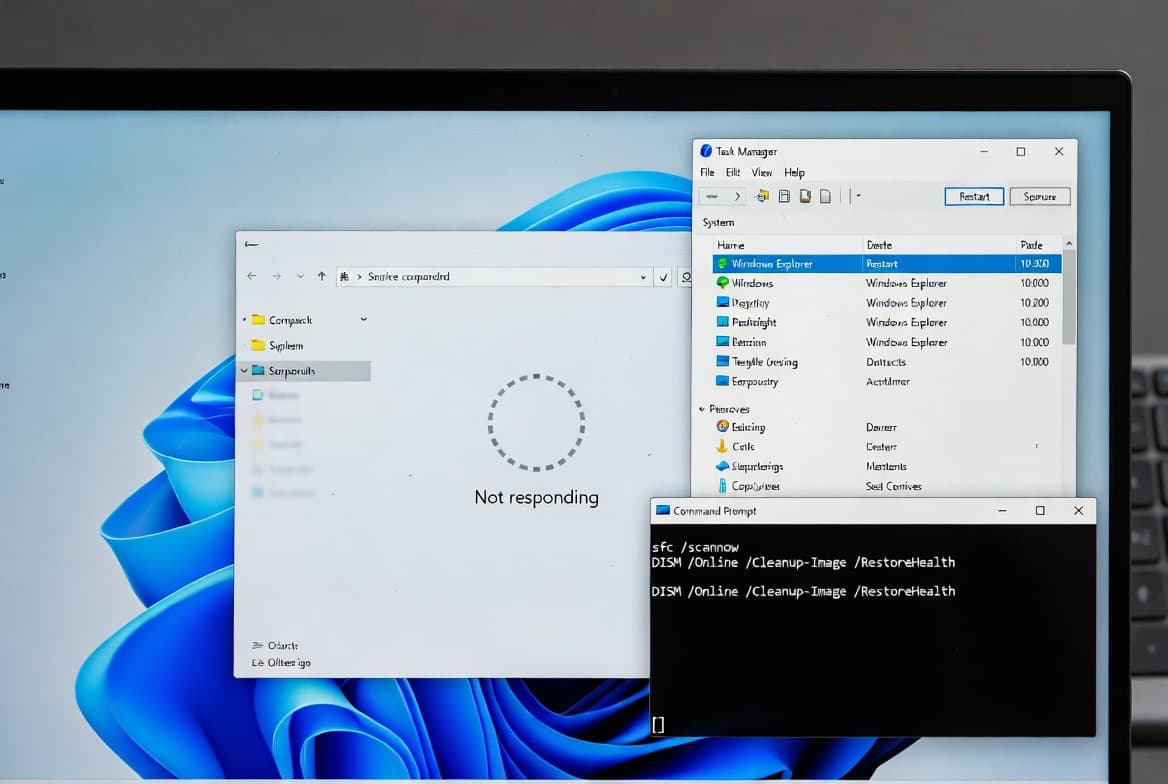
- Windows Sandbox no longer stops responding at startup with error 0x800705b4.
- The lock screen is more reliable against becoming unresponsive.
- The Automatically hide the taskbar setting no longer turns off unexpectedly after a toolbar-conflict message appears.
- Joining the Windows Insider Program through Settings > Windows Update is less likely to get stuck.
- Settings > Network & Internet no longer causes Settings to become unresponsive.
- The Settings search bar no longer overlaps the Minimize and Maximize title-bar buttons.
Known issues
Microsoft lists no known issues for this update at the time of writing.
How to get this update
This update is distributed through two phases: a gradual rollout, which delivers the update to devices incrementally over time, and a normal rollout, which is a broad release to all eligible devices. Administrators can obtain the update through the following channels:
- Windows Update / Windows Update for Business: The update appears automatically for eligible Windows 11 version 26H1 devices.
- Microsoft Update Catalog: Search for KB5077239 to download the standalone package. Note that catalog MSU command strings were updated on May 26, 2026.
- WSUS: Import the package from the Microsoft Update Catalog for managed deployment environments.
No prerequisite servicing stack update is called out explicitly for this release in the page text.
Frequently asked questions
Is KB5077239 a security update?
No. KB5077239 is an optional non-security preview update. It does carry the latest security fixes accumulated to date, but its primary purpose is to deliver non-security improvements and new features ahead of the next monthly security release. Deploying it is voluntary, not mandatory, for organizations on a standard patching cadence.
What is the difference between the gradual rollout and the normal rollout for this update?
A gradual rollout delivers the update to devices in phases over time, so not every eligible device receives all features simultaneously. A normal rollout is the broad release to all eligible devices at once, typically when the update reaches general availability. Some features in this release are initially limited to a small group of devices even within the gradual rollout.
Do the new Secure Boot PowerShell cmdlets require any additional tools?
The two new cmdlets - Get-SecureBootUEFI with the -Decoded option and Get-SecureBootSVN - are part of this update itself. The separate App SDK and Tools package for Windows MIDI Services is an independent download from the Windows MIDI Services landing page or GitHub, and Microsoft notes it is currently unsigned, which may trigger a security warning during download or installation.
Does the Windows Hello Enhanced Sign-in Security expansion require specific hardware?
Yes. ESS for peripheral fingerprint sensors requires a supported ESS-compatible fingerprint reader. Once a supported reader is connected, administrators or users can enroll by navigating to Settings > Accounts > Sign-in options. This extends ESS beyond devices with built-in fingerprint sensors to desktops and other Windows 11 PCs, including Copilot+ PCs.