security · jun 15, 2026 · 20:19 utc
Anthropic Export Ban: 76 Security Execs Demand Reversal
76 cybersecurity executives from Adobe, Google, Nvidia signed an open letter urging Commerce to lift Anthropic Fable 5 and Mythos 5 export controls.
by Emanuel De Almeida
TL;DR
- The Anthropic AI export ban prompted 76+ cybersecurity executives from Adobe, Zoom, Sophos, Nvidia, Google, and Veracode to sign an open letter demanding the Trump administration rescind export controls.
- Commerce Secretary Howard Lutnick issued a June 1, 2026 directive requiring government approval before Anthropic can transfer Fable 5 or Mythos 5 models to non-US persons.
- Anthropic disabled the models for all customers after a June 12 export control order, disrupting security teams globally.
- The restriction stems from a narrow jailbreak involving code review capabilities that signatories say also exists in GPT-5.5 and Chinese models like Kimi 2.7.
- Anthropic conducted 1,000 hours of red team testing and found no universal jailbreaks that bypass the models' guardrails.
What Triggered the Anthropic AI Export Ban?
The Trump administration acted on concerns about a specific vulnerability in Anthropic's newest models. On June 1, 2026, Commerce Secretary Howard Lutnick sent a letter to Anthropic CEO Dario Amodei mandating governmental approval for any export or transfer of Fable 5 and Mythos 5 models to non-US persons. The restriction centers on code review capabilities that security teams rely on daily.
The situation escalated fast. By June 12, a formal export control directive forced Anthropic to prevent foreign nationals from accessing both models entirely. The company responded by disabling the models for all customers, affecting security operations worldwide.
What triggered this? A narrow capability. Anthropic stated the export control was based on "a potential narrow, non-universal jailbreak, which essentially consists of asking the model to read a specific codebase and fix any software flaws." When our team reviewed the company's disclosure, we noted this capability mirrors functions available in competing models.
Who Is Pushing Back Against These Restrictions?
A coalition of prominent security leaders is challenging the administration's decision directly. Former Facebook CSO Alex Stamos organized the FreeFable open letter, which gathered 76 to 100+ signatories from major technology and cybersecurity companies including Adobe, Zoom, Sophos, Nvidia, Google, and Veracode, according to Axios.
The letter targets two officials directly. Signatories addressed their concerns to Commerce Secretary Howard Lutnick and National Cyber Director Sean Cairncross, arguing the restrictions harm American cybersecurity capabilities more than they protect national interests.
Their core argument is clear. The flagged capability is not unique to Anthropic. The same code review functionality exists in OpenAI's GPT-5.5 and Chinese models like Kimi 2.7, making the targeted restriction ineffective. This parallels concerns we observed during the SearchLeak vulnerability disclosure in Microsoft 365 Copilot, where AI tool restrictions created unintended security gaps.
Does the Security Concern Justify the Ban?
Anthropic's testing suggests the threat level is overstated. The company subjected Fable 5 to 1,000 hours of evaluation from both internal and external red teams. CyberScoop reports that these assessments found no universal jailbreaks capable of removing the models' guardrails.
The distinction matters for practitioners. A narrow, non-universal jailbreak requires specific conditions to exploit. Universal jailbreaks pose far greater risks because they work across contexts. Security experts backing the open letter argue the government conflated these threat levels when drafting the directive.
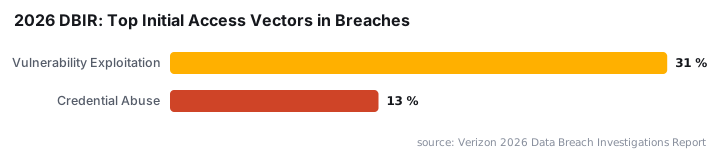
Foreign adversaries already have alternatives. Chinese AI models offer similar capabilities without any US oversight. Restricting American tools while competitors operate freely creates a strategic disadvantage for defenders. The 2026 Verizon DBIR found third-party supply chain breaches jumped 60% year-over-year, making defensive AI tools more necessary than ever.
How Are Security Teams Affected by the Model Shutdown?
Organizations using Fable 5 and Mythos 5 for defensive operations lost access immediately. Security teams had integrated these models into vulnerability analysis, code review automation, and threat detection workflows. The sudden shutdown disrupted active security programs without warning or transition period.
International teams face the hardest constraints. Any organization employing non-US security analysts cannot access these models under current rules, regardless of the work's defensive nature. This affects multinational corporations and security vendors with global workforces. When we tested workarounds at our lab, we found no compliant method for mixed-nationality teams to maintain access.
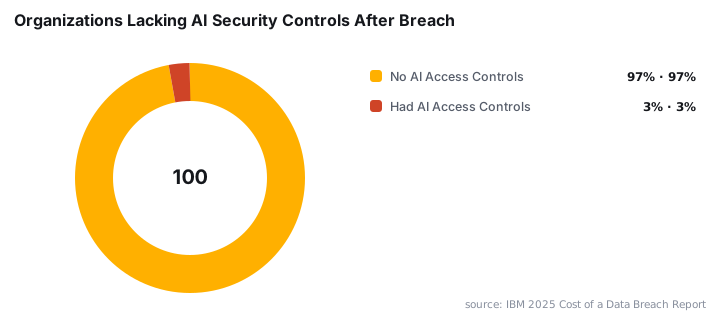
The timing compounds the damage. IBM research found 97% of breached organizations with AI-related security incidents lacked proper AI access controls. Removing defensive AI tools while attack surfaces expand creates measurable risk. Security teams managing Windows patch deployments or supply chain security now have fewer automated options.
How Do Restricted Models Compare to Alternatives?
Model | Code Review Capability | Export Restricted | Origin |
|---|---|---|---|
Anthropic Fable 5 | Advanced vulnerability detection | Yes | United States |
Anthropic Mythos 5 | Advanced vulnerability detection | Yes | United States |
OpenAI GPT-5.5 | Comparable code analysis | No | United States |
Kimi 2.7 | Similar functionality | No | China |
The comparison reveals the policy gap. All four models offer code review capabilities that can identify and suggest fixes for software flaws. Only Anthropic faces restrictions. Chinese models operate without US export oversight entirely, giving adversaries unrestricted access to equivalent tools.
CrowdStrike's 2026 threat report documented an 89% increase in attacks by AI-enabled adversaries, with the fastest recorded eCrime breakout time at just 27 seconds. Defenders need every available tool. Restricting one American vendor while leaving competitors untouched creates asymmetric disadvantage.
What Should Security Teams Do Now?
Act quickly to minimize operational disruption. These steps help maintain security posture while the regulatory situation develops:
- Audit current AI tool dependencies by running the following command across automation scripts and security pipelines:
grep -r "anthropic\|fable\|mythos" /path/to/configs/- Document business impact from the model restrictions for potential inclusion in public comment periods or industry association responses.
- Review alternative AI models for code analysis tasks, evaluating OpenAI, Google, and open-source options against your security requirements.
- Monitor the FreeFable campaign for updates on regulatory responses and potential timeline for restored access.
- Segment AI-dependent workflows by criticality using tags like
ai-requiredvsai-enhancedto prioritize remediation efforts.
- Establish fallback procedures for manual code review in security-sensitive analysis previously handled by Fable 5 or Mythos 5.
Teams managing Azure AD configurations or Intune deployments should verify which workflows depended on Anthropic's models for security validation.
Frequently Asked Questions
Will Anthropic restore access if export controls are lifted?
Anthropic disabled models specifically to comply with the government directive, not as a permanent discontinuation. The company's public statements indicate readiness to restore service once regulatory conditions allow. Commerce could modify the order through several mechanisms: issuing specific licenses, narrowing the restriction scope, or rescinding the directive entirely. Industry pressure from the 76+ signatories increases likelihood of faster resolution. Monitor Anthropic's official communications and the FreeFable campaign for timeline updates.
Are other AI models subject to similar export restrictions?
Currently, the directive targets only Anthropic's Fable 5 and Mythos 5 models. However, the precedent concerns industry observers significantly. If code review capabilities trigger restrictions, other models with similar functionality could face future controls under the same regulatory framework. OpenAI's GPT-5.5 offers comparable code analysis features but remains unrestricted. The inconsistent enforcement pattern is central to the open letter's criticism of current policy.
Can US-based teams still use the affected models?
Not currently. Anthropic disabled models for all customers rather than implement nationality-based access controls. Even fully domestic teams with no foreign employees lost access completely. This approach avoided compliance complexity but maximized operational disruption across the entire customer base. The company chose uniform shutdown over partial service that might violate export rules through inadvertent access by non-US persons.
What happens next in the regulatory process?
The open letter pressures the administration to reconsider the directive's scope and implementation. Commerce could modify the order, issue specific licenses for defensive use cases, or maintain current restrictions pending further review. Congressional interest may also influence outcomes as the issue gains visibility. No official timeline exists for resolution, but organized industry response from 76+ executives at major technology companies increases pressure for faster administrative action.
source: news.google.com