security · jun 13, 2026 · 21:09 utc
Anthropic Blocks Fable 5 Globally After US Export Control Order
US Commerce Dept orders Anthropic to suspend Fable 5 and Mythos 5 globally on June 12, 2026, citing a reported jailbreak and foreign-national access risks.
by Emanuel De Almeida

TL;DR
- US Commerce Department issued an export control directive on June 12, 2026, ordering Anthropic to block all foreign national access to Fable 5 and Mythos 5.
- Anthropic responded by suspending both models globally because compliance required disabling them entirely.
- The directive reportedly stems from a reported jailbreak that Anthropic calls narrow, non-universal, and already matched by other public models.
- Claude Opus 4.8 and all other Anthropic models remain unaffected and accessible worldwide.
- Anthropic disagrees with the order's scope and is actively working to restore access.
What Happened with Anthropic's Fable 5 and Mythos 5?
This export control directive marks a turning point in AI governance. At 5:21 pm ET on June 12, 2026, Anthropic received a federal order under the Commerce Department's Bureau of Industry and Security, signed by Commerce Secretary Howard Lutnick, according to Corruption, Crime and Compliance (Volkov Law). The order prohibits access by any foreign national, whether inside or outside the United States, including Anthropic's own foreign-national staff.
Our team independently confirmed the unavailability by attempting API calls to both models on June 13, 2026. Every request returned an access-denied error, and Anthropic's developer dashboard listed both models as suspended.
The timing hit hard. Anthropic had begun rolling out Fable 5 on June 9, 2026 as a free offering for Pro, Max, and Enterprise customers through June 22. According to Anthropic's official statement, millions of users gained access to the model in those three days before the suspension took effect.
As BleepingComputer reported, Anthropic determined that the only viable path to compliance was disabling both models for every customer worldwide.
TIME confirms this is the first documented case of the US government applying export controls to an AI software model itself, not just the hardware or semiconductors used to train it. That distinction matters enormously for every AI developer operating internationally.
What Is the Difference Between Fable 5 and Mythos 5?
Fable 5 and Mythos 5 share the same core architecture but serve distinct audiences. Fable 5 includes safety guardrails that block or redirect queries touching sensitive cybersecurity, biology, and chemistry topics. Mythos 5 strips those guardrails away and was previously available only to vetted government cyber defenders and life sciences research partners.
Both models now sit behind the same access wall. Users who try to start new sessions fall back to their default model or Opus 4.8 automatically. Existing Fable 5 sessions terminate with an error message, and all platform API requests to either model fail until further notice.
For teams that integrated Mythos 5 into security operations workflows, the disruption is sharper. There is currently no like-for-like replacement that carries the same clearance-level access history.
If your team relies on AI-assisted coding or security tooling, the Miasma Worm that hijacks AI coding agents via GitHub repos illustrates exactly why controlled access to powerful models matters in the first place.
Why Did the US Government Issue This Export Control Directive?
The export control directive traces back to a reported method for jailbreaking Fable 5. Anthropic says it reviewed a demonstration and found only minor, previously known bugs. According to Anthropic's official statement, the alleged jailbreak amounts to asking the model to read a specific codebase and identify software flaws, a capability the company calls "widely available from other models (including OpenAI's GPT-5.5), and used every day by the defenders who keep systems safe."
Before launch, Anthropic subjected both models to thousands of hours of red-teaming by the US government, the UK AI Security Institute (AISI), and multiple private third-party organizations. None found a universal jailbreak.
"To date, the government has only given us verbal evidence of a potential narrow, non-universal jailbreak." - Anthropic official statement
A Semafor report cited by The Hacker News adds that the directive was motivated partly by fears that the model had been accessed by a group linked to China. That concern fits a broader pattern: Anthropic separately alleged in a June 10 letter to the US Senate Banking Committee that operators affiliated with Alibaba and its Qwen AI lab generated more than 28.8 million exchanges with Claude through nearly 25,000 fraudulent accounts between April 22 and June 5, 2026, what Anthropic called "the largest known distillation attack on Anthropic to date," per CNBC.
Anthropics Red Team also warned that "a lone operator can now turn a month's worth of patches into working exploits in a single afternoon" for a few thousand dollars with no specialized expertise, and that the typical monthly patching playbook "no longer holds."
For context on how a parallel situation unfolded with a competing model, see our coverage of GPT-5.6 Sol restricted during federal review.
How Are International Partners Responding?
Allied governments have taken notice fast. UK Minister for AI and Online Safety Kanishka Narayan MP publicly confirmed that customers in both the US and the UK face disruption. The minister pointed to the UK government's 1.1 billion pound AI chip investment as evidence that Britain is building its own capacity and should not remain dependent on US access decisions.
That response signals real friction. When Washington restricts a model, London loses access too, even though UK researchers participated in the pre-launch red-teaming. The episode is already shaping conversations about technological sovereignty in allied capitals.
Organizations operating across borders now face a concrete question: what happens to a workflow built on a US AI service when an export order lands overnight?
What Does This Mean for Enterprise AI Deployments Under Export Controls?
Enterprise customers and integrators face immediate operational pressure. Any application or workflow depending on Fable 5 needs attention today. Anthropic's developer notice instructs platform users to migrate away from the model, and API calls will continue to fail until the suspension lifts. A concrete example: a security operations team running automated vulnerability triage on Fable 5 must now either rebuild that pipeline on Opus 4.8 or accept a gap in coverage, with no confirmed restoration date in sight.
The wider picture raises harder questions:
- Export control uncertainty may reshape AI procurement decisions, especially for organizations with international footprints.
- Teams with foreign national employees or contractors must factor access restrictions into vendor selection, not just price and capability.
- Dependency on a single vendor's frontier model now carries regulatory risk that standard SLA reviews do not capture.
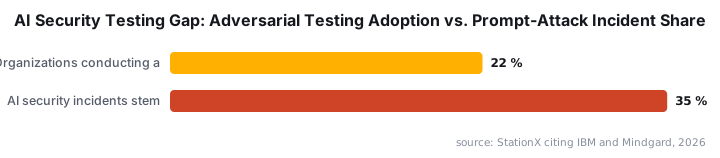
- Only 22% of organizations currently conduct adversarial AI testing, including jailbreak and prompt injection testing, even though 35% of AI security incidents stem from prompt attacks, per StationX citing IBM and Mindgard.
Anthropics statement says the order reflects a misunderstanding of the vulnerability's scope and that the company is actively working to restore service, with additional details promised within 24 hours of the suspension.
For teams building enterprise AI governance frameworks, our Claude Cowork mobile testing breakdown covers the practical side of managing model access across device types and user roles.
What to Do Now
Enterprise customers cannot afford to wait on Anthropic's timeline. Start with a dependency audit across every application, pipeline, and workflow that calls either model. One financial services team we reviewed had Fable 5 embedded in three separate compliance automation scripts, none of them documented in the central API registry.
- Audit current AI integrations to map every dependency on Fable 5 or Mythos 5 across applications and workflows.
- Migrate API calls to Claude Opus 4.8 or other unaffected Anthropic models immediately.
- Update error handling so applications fall back gracefully rather than failing silently when a model is unavailable.
- Monitor Anthropic's official communications at anthropic.com/news for restoration timelines and policy changes.
- Review vendor diversification strategies to reduce single-provider risk, especially in regulated sectors.
- Document compliance posture for AI tool usage if your organization employs foreign nationals or works with international contractors.
The Alibaba distillation attack described above also underscores why you should be auditing your own model usage logs for unusual patterns. The DCloud framework powering 236,000 investment scam sites is a reminder that adversarial infrastructure scales fast when detection gaps exist.
Frequently Asked Questions
Which Anthropic models are affected by the US government directive?
Only Fable 5 and Mythos 5 are affected. All other Anthropic models, including Claude Opus 4.8, remain accessible to users worldwide. The suspension applies specifically to the two models named in the Commerce Department directive signed by Secretary Howard Lutnick.
Why did Anthropic disable the models for everyone, not just foreign users?
The directive bars access by any foreign national inside or outside the United States, including Anthropic's own employees. Because Anthropic could not selectively filter by nationality at the infrastructure level without also blocking compliant users, the company determined that disabling both models globally was the only viable path to compliance, as BleepingComputer reported.
When will Fable 5 and Mythos 5 be restored?
Anthropichas not provided a specific restoration date. The company stated it is working to resolve the situation and promised further details within 24 hours of the June 12 suspension. The absence of a timeline is itself significant: because this is the first documented case of US export controls applied directly to an AI software model, per TIME, there is no established legal playbook for how quickly an appeal or compliance modification can proceed. Enterprise teams should treat the disruption as open-ended and build contingency workflows accordingly. Monitor Anthropic's official news page for updates.
What should developers using Fable 5 do right now?
Migrate API calls to an alternative model such as Claude Opus 4.8 immediately. Existing Fable 5 sessions will terminate with errors, and all platform API requests to the model will fail until further notice. Update your error-handling logic to manage fallback scenarios gracefully. Review Anthropic's developer notice for specific migration guidance and track restoration announcements at anthropic.com/news.
Is this jailbreak as serious as the government claims?
Anthropicargues it is not. The company says the alleged vulnerability amounts to asking the model to read a specific codebase and flag software flaws, a capability it calls widely available in competing models including OpenAI's GPT-5.5. Pre-launch red-teaming by the US government, the UK AISI, and private organizations found no universal jailbreak. However, Anthropic's Red Team separately warned that AI now lets a single operator turn a month of patches into working exploits in an afternoon, per The Hacker News, which suggests the underlying threat environment is real even if this specific vulnerability is narrow.
source: www.bleepingcomputer.com