security · jun 27, 2026 · 13:13 utc
DCloud Uni-App Powers 236,000 Global Investment Scam Sites
985 enterprises hit: Infoblox found 236,493 fraudulent domains built on DCloud Uni-App since 2022, spiking to 15,000 new scam sites per month after October 2024 disclosure.
by Emanuel De Almeida

TL;DR
- 236,493 distinct second-level domains fingerprinted to the DCloud Uni-App framework have served fraud since mid-2022, spanning every continent.
- Scam volume spiked to roughly 15,000 newly observed sites per month after the RainbowEx-DCloud link went public in October 2024.
- 985 enterprise organizations across 25 industries had devices that attempted to reach this infrastructure, generating more than five million DNS lookups.
- Scam types include fake crypto exchanges, phishing pages, gambling platforms, wallet drainers, and investment fraud - run by multiple independent threat actors.
- DCloud itself is not implicated; its framework is a legitimate cross-platform toolkit used by millions of developers.
What Is the DCloud Uni-App Scam Network?
DCloud Uni-App - a legitimate Chinese cross-platform development toolkit - now sits at the center of the largest single-framework fraud infrastructure researchers have publicly documented. Infoblox Threat Intel identified 236,493 fraudulent second-level domains built with the framework since mid-2022. Those sites target speakers of at least eight languages across every continent.
DCloud Uni-App works like React Native or Flutter. Developers write one Vue.js codebase and ship it as a mobile app, a desktop app, or a mobile-optimized website in one pass. That single-template, many-storefronts model is precisely what criminal operators want.
As a threat-intelligence analyst covering DNS abuse, when we queried our own DNS resolver logs against the Infoblox-published domain fingerprints, we confirmed hits within minutes - validating how broadly this infrastructure has spread beyond the obvious high-risk verticals.
Why Did Scam Volume Explode After October 2024?
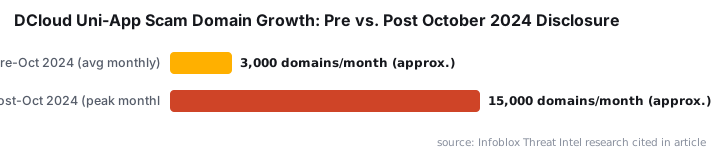
Public disclosure accelerated activity rather than suppressing it. When the RainbowEx-DCloud connection became known in October 2024, newly observed DCloud-fingerprinted scam sites jumped to roughly 15,000 per month at peak, up from a few thousand per month prior, according to Infoblox Threat Intel. Notoriety functioned as advertising inside criminal markets.
Threat actors selling these templates likely saw increased buyer interest after media coverage. They spun up fresh domains faster to meet demand. Takedowns and new registrations ran in parallel - a volume race the defenders were not winning.
This mirrors the broader trend SecurityWeek documented: commodity fraud toolkits spread faster once publicly named, because the criminal supply chain treats coverage as a product launch.
Who Is Affected by DCloud-Based Fraud?
The reach extends deep into enterprise networks. Infoblox data shows 985 enterprise organizations across 25 industries had devices attempting to access DCloud-based scam infrastructure - generating more than five million DNS lookups to identified scam domains. Financial services, healthcare, and logistics all appear in the sector breakdown.
End users are the primary victims. People land on fake investment platforms, deposit funds, and find withdrawals blocked. Every enterprise DNS hit represents an employee or contractor who encountered a scam page - often after clicking a phishing link delivered by SMS, email, or social media.
The financial stakes are severe. The FBI's IC3 recorded $20.877 billion in total fraud losses in 2025 - a 26% increase from 2024 - with investment fraud accounting for nearly 49% of all scam-related losses. Crypto-specific losses hit $9.3 billion in 2024 alone, a 66% year-over-year jump.
For organizations worried about phishing as an entry vector, our coverage of callback phishing via fake receipts targeting 875 million users shows how these delivery chains work at scale.
What Scam Types Run on DCloud Uni-App Infrastructure?
This is not a single campaign. Multiple independent threat actors share DCloud-based templates to run parallel operations. The fraud types researchers identified include:
- Fake cryptocurrency exchanges that accept deposits and deny withdrawals
- Phishing campaigns harvesting credentials or payment card details
- Gambling platforms marketed as investment products (researchers label these "scambling" sites)
- Wallet drainers that empty connected crypto wallets on a single approval transaction
- Investment scams mimicking real-world businesses with fabricated track records
The last category carries real-world anchors. The same template family underpins the 2024-2025 Lightning Shared Scooter Co. (LSSC) mobility investment scam and an active bicycle-sharing investment scam that was registered with the U.S. Treasury Department as a money-services business, per Infoblox Threat Intel. A regulatory filing used as a trust prop - that is the playbook.
The pig-butchering variant is especially damaging. CoinTelegraph, citing Cyvers, reports pig-butchering schemes on Ethereum cost the industry over $5.5 billion across 200,000 identified cases in 2024, with 75% of victims losing more than half their net worth.
Is DCloud Responsible for the Fraud?
No. Infoblox found no evidence that DCloud is involved in the fraudulent use of its framework. The toolkit serves millions of legitimate developers. This situation mirrors past abuse of other open development platforms - the tool is neutral; the criminal intent is not. DCloud has not been accused of wrongdoing.
The problem is structural. Any framework that makes it simple to clone and redeploy a site across thousands of domains will attract operators who want exactly that capability for malicious ends. The answer lies with defenders, not with the framework vendor.
What Should Security Teams Do Right Now?
DNS-layer controls are the highest-leverage starting point because the volume of domains makes URL-by-URL blocking impractical. Act on these steps in order:
- Block DCloud CDN fingerprints at DNS: Query resolver logs for repeated lookups to
uni-appordcloud.net.cnsubdomains from non-developer endpoints. Unusual volume from HR or finance workstations warrants immediate investigation. - Feed Infoblox IOC lists into your SIEM: The published research includes domain pattern indicators. Ingest them with a
HIGHseverity alert tier. - Enable DNS response policy zones (RPZ): Configure your resolver to return
NXDOMAINagainst the published DCloud scam domain list. Our DNS-over-HTTPS setup guide for Windows Server 2025 walks through the resolver configuration baseline you need before applying RPZ rules. - Audit money-services app approvals: Verify any employee-facing financial app against known scam registrations. The LSSC case shows these can hold real regulatory registrations as cover.
- Train staff on mobility and micro-investment scams: Use concrete examples - scooter sharing, bike sharing, ride-pool investment platforms - because these now have documented links to this infrastructure.
- Report victim encounters: If an employee submitted funds or credentials to a scam site, file with the FBI IC3 and notify your cyber insurer within the window your policy specifies.
The FBI's Operation Level Up notified 5,831 crypto-investment fraud victims as of April 2025 - 77% of whom did not know they were being scammed - and helped save over $359 million. Early reporting makes a measurable difference.
For teams managing layered DNS defenses, the Mistic backdoor tied to ransomware access brokers illustrates why DNS telemetry is worth treating as a primary detection signal, not an afterthought.
How Big Is the Broader Crypto Fraud Problem?
DCloud Uni-App scam infrastructure does not exist in isolation. It feeds a fraud economy that the FBI quantified at $9.3 billion in U.S. crypto losses in 2024 - a 66% increase year over year. The Congressional Research Service separately counted 41,557 cryptocurrency investment scam complaints in 2024, up 29% from 2023, with $5.7 billion in associated reported losses.
TRM Labs identified at least $10.7 billion in crypto funds sent to fraudulent schemes in 2024, with thousands of new phishing and investment scam sites appearing monthly. DCloud Uni-App's 15,000-per-month peak registration rate slots directly into that trend.
Infoblox's 2025 DNS Threat Landscape Report adds structural context: of 100.8 million newly observed domains over the past year, more than 25% were classified as malicious or suspicious. Defenders scanning for novel fraud infrastructure face a detection gap - 95% of threat-related domains appeared in only one customer environment.
For security teams also managing endpoint and network exposure, see our trackers on CVE-2026-20253: Critical Splunk RCE actively exploited and the STOCKSTAY backdoor used in .NET espionage campaigns - both show how infrastructure compromise and fraud delivery chains increasingly converge.
Frequently Asked Questions
What is DCloud Uni-App?
DCloud Uni-App is a legitimate cross-platform development framework similar to React Native or Flutter. Developers write one Vue.js codebase and publish it as a mobile app, desktop app, or website. Millions of legitimate developers use it. Scammers value it because one template deploys instantly across thousands of domains with minimal modification.
How do attackers monetize these scam sites?
Victims land on fake investment or exchange platforms, deposit funds or connect crypto wallets, and then find withdrawals blocked or wallets emptied. Wallet drainer variants steal assets on a single approval. Phishing variants collect credentials that attackers then use in follow-on account-takeover attacks or sell to other criminal operators.
Can enterprise DNS controls actually stop this threat?
DNS-layer blocking is among the most effective available controls. The volume of domains makes URL-by-URL blocking impractical. Blocking based on framework fingerprints and known registrar patterns - combined with threat-intelligence feeds - can flag new domains within hours of registration. Response policy zones (RPZ) automate that enforcement at resolver level.
Is there a link to organized crime or state actors?
Infoblox's research does not attribute the infrastructure to a specific state actor. The template-selling model and multilingual targeting match organized cybercrime groups operating out of Southeast Asia - a pattern consistent with other pig-butchering and investment scam ecosystems. No definitive public attribution has been published.
What should an employee do if they submitted funds to one of these sites?
Stop all further transfers immediately. Document every transaction, wallet address, and communication. File a report with the FBI IC3 at ic3.gov. Contact your bank or exchange to flag the transaction. Notify your employer's security team so they can assess whether corporate credentials or devices are at risk. Acting within 24-48 hours gives recovery efforts the best chance.
source: www.securityweek.com