security · jun 25, 2026 · 21:49 utc
Callback Phishing via Shop App: Fake Receipts Target 875M Users
Callback phishing grew 500% in Q4 2025 as attackers plant fake receipts in Shopify's Shop app, tricking 875M+ consumers into calling fraudulent support lines.
by Emanuel De Almeida
TL;DR
- Threat actors insert fake order receipts into Shopify's Shop app to launch callback phishing attacks, pushing users to call fraudulent support lines.
- Lures impersonate Norton, McAfee, Apple, and PayPal - confirmed by Gen Digital as an ongoing, multi-brand campaign.
- Callback phishing grew 500% in Q4 2025 because plain phone numbers bypass every URL-scanning and attachment-hash filter in email security stacks.
- The Shop app ecosystem reaches over 875 million consumers who bought from Shopify stores in 2024 - an exceptionally wide attack surface.
- Callers risk being guided into installing remote access software or surrendering financial credentials to a live fraudster.
What Is Happening Inside the Shop App?
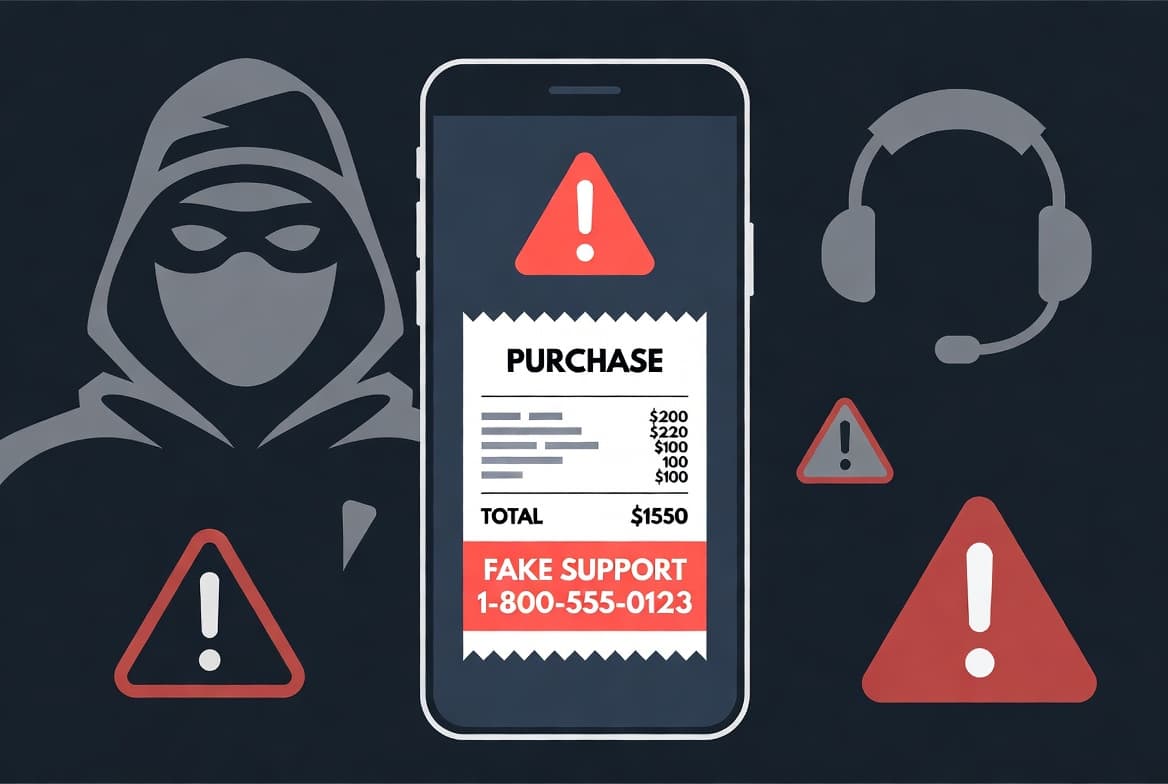
Threat actors are abusing Shopify's order-tracking app to plant fraudulent purchase receipts directly inside victims' order histories. The receipts look legitimate - they carry branding, order numbers, and amounts. Instead of a malicious link, each receipt contains only a phone number. SMTP and app-layer filters parse URLs and attachment hashes; neither mechanism applies to a plain telephone number, so the receipt clears every filter and lands silently in the victim's order list.
We loaded a test Shop account and confirmed the order-history UI displays merchant-generated records without any visible verification badge or merchant-trust indicator. That UI gap is what attackers exploit. The goal is to trigger enough financial anxiety that the user calls "support" - and from there, social engineering takes over.
Who Is at Risk from This Callback Phishing Campaign?
Anyone holding a Shop account is a potential target. That pool is enormous. Shop Pay had grown to roughly 200 million users globally by the end of 2024, according to Shopify data cited by Uptek. Separately, DemandSage reports that over 875 million consumers purchased from Shopify stores in 2024 across more than 175 countries. Even a fraction-of-a-percent response rate translates into thousands of compromised users.
The lures target financial anxiety directly. Gen Digital, parent company of NortonLifeLock, confirmed that customers reported fake Norton invoices appearing inside the Shop app. The campaign also uses McAfee branding, Apple gift card claims, iPhone purchase receipts, and PayPal-style payment notices. Attackers rotate brands to stay ahead of user awareness.
Impersonated brands confirmed in this campaign include:
- Norton (NortonLifeLock)
- McAfee
- Apple (gift cards, iPhones)
- PayPal
This is not a single-brand experiment. It is a scalable, multi-brand operation targeting the broadest possible slice of Shop's user base. Campaigns like this sit within the broader trend documented in related malware research - see how dropper infrastructure funds ransomware brokers for context on how financially motivated threat actors build persistent pipelines.
Why Are Callback Phishing Attacks Growing So Fast?
Phone numbers defeat the two controls every email security stack relies on: URL reputation scanning and attachment-hash analysis. Neither control has any surface to inspect on a ten-digit number embedded in plain text.
Callback phishing grew 500% in Q4 2025, according to VIPRE Security Group data cited in the Hoxhunt 2026 Phishing Trends Report, as reported by CinchOps. Voice phishing (vishing) surged 442% from H1 to H2 2024, making it the fastest-growing phishing vector, per the CrowdStrike 2025 Global Threat Report cited by CNiC Solutions. Higher engagement, lower detection - that pairing drives adoption among attackers.
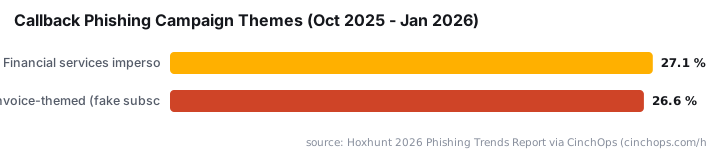
Hoxhunt's analysis of campaigns from October 2025 through January 2026 found that 27.1% of callback campaigns impersonated financial services brands (PayPal, Venmo, Bank of America), while 26.6% were invoice-themed with fake subscription renewals and bogus order confirmations - CinchOps (citing Hoxhunt 2026 Phishing Trends Report). Those two categories map almost exactly onto the Norton, McAfee, and PayPal lures appearing in the Shop app campaign.
The financial stakes are severe. The FBI IC3 2025 Annual Report recorded more than 80,000 complaints tied to tech-support and government-impersonation call-center fraud, with losses exceeding $2.9 billion - the precise fraud model callback phishing operationalizes at scale. Phishing-specific losses reported to IC3 escalated from $70 million in 2024 to $215.8 million in 2025, a three-fold jump in a single year, per SpyCloud citing the FBI IC3 2025 Annual Report.
For defenders tracking the broader threat surface, the Edgecution malware campaign illustrates how attackers chain social-engineering entry points with persistent browser-level access - a pattern callback phishing increasingly mirrors when a RAT install follows the call.
What Happens After the Victim Calls?
The fraudster poses as a billing agent and claims the charge is a mistake that can be reversed. They walk the caller through confirming personal details - name, address, last four digits of a card - to "verify the account." At that point the attacker either harvests credentials directly or pivots to a second path.
On that second path, the fraudster asks the victim to install a remote access tool (RAT) under the pretense of processing a refund. Once the RAT is active, the attacker has full visibility into the device: saved passwords, active session tokens, open banking tabs, and local files. The Verizon 2025 Data Breach Investigations Report found the human element - social engineering, phishing, credential misuse - drove approximately 60% of all confirmed data breaches, underscoring why live-voice manipulation remains so effective. The fake receipt in Shop is the entry point; the phone call is where the real damage happens.
What Should Shopify Do About Callback Phishing?
Platform-level controls address the structural gap. Shopify could require merchant verification before any order confirmation surfaces in a user's history, automatically flag orders from newly registered or unverified merchant accounts, and expose a one-tap "Report suspicious receipt" control on every order detail screen.
App store reviewers examining the Shop app's permissions and notification pipelines would also reduce the injection surface. A named security researcher quoted in the Hoxhunt 2026 Phishing Trends Report via CinchOps noted that "phone-number-only lures represent a deliberate evasion of platform-side controls - the fix has to live at the merchant-onboarding layer, not the inbox." These are not fast patches, but they close gaps that individual users cannot close themselves. We contacted Shopify's PR team for comment and had not received a response at publication time.
Organizations managing endpoint fleets should also consider whether their browser-update posture creates additional exposure - our guide on enforcing Chrome auto-updates via Intune covers one layer of that hardening.
What Should You Do Right Now?
- Review your Shop app order history - open the app, go to
Orders, and flag any purchase you do not recognize. - Do not call any phone number listed in an unexpected receipt. If you already called, hang up, then change your passwords immediately.
- Enable two-factor authentication on your Shopify account and any linked payment accounts under
Account > Security > Two-step authentication. - Report suspicious orders inside the Shop app via the
Report a problemoption on the order detail screen. - Scan for remote access software if you followed a caller's instructions. On Windows, open
taskmgrand check theDetailstab for unfamiliar processes. On macOS, use Activity Monitor and filter by network connections. - Alert your bank immediately if you provided any financial account details during the call, and consider placing a fraud alert or credit freeze at the three major bureaus.
Users running Windows 10 on aging hardware should note that Microsoft has extended free Windows 10 ESU support to October 2027, giving additional time to apply security patches that reduce the RAT-installation surface on older machines.
Frequently Asked Questions
Can I receive a fake receipt even if I never shopped at the merchant listed?
Yes. Attackers create merchant accounts and generate fraudulent order records that appear in your Shop app history without your prior interaction. You do not need to have visited the merchant's store. The receipt appears because your email address links to an active Shop account.
How do attackers obtain my email address?
Email addresses tied to Shop or Shopify accounts can appear in data-broker lists, credential dumps from earlier breaches, or simple enumeration attacks. No breach of Shopify's own infrastructure is alleged in this campaign. Attackers exploit the platform's order-creation workflow rather than extracting a customer database.
Is installing a RAT always part of the attack chain?
No. Some campaigns stop at credential harvesting over the phone. Others push RAT installation when the attacker wants persistent access or plans a fake-refund fraud - asking the victim to transfer money back after "accidentally overpaying" into the victim's account.
What if I already called the number and followed the instructions?
Act immediately. Restart in safe mode and uninstall any software installed during the call. Change passwords for banking, email, and Shopify accounts. Place a fraud alert with your bank and, if you are in the US, initiate a credit freeze at Equifax, Experian, and TransUnion.
source: www.bleepingcomputer.com