vulnerabilities · jun 26, 2026 · 21:18 utc
CVE-2026-20253: Critical Splunk RCE Actively Exploited
A CVSS 9.8 pre-auth RCE flaw in Splunk Enterprise is under active attack. CISA added it to KEV on June 18. Over 1,400 instances exposed. Patch by June 21.
by Emanuel De Almeida

TL;DR
- CVE-2026-20253 carries a CVSS v3.1 score of 9.8 (Critical) and allows unauthenticated remote code execution on unpatched Splunk Enterprise instances.
- Affected versions: Splunk Enterprise 10.2.0-10.2.3 and 10.0.0-10.0.6; fixed in 10.2.4, 10.0.7, and 10.4.0.
- A public proof-of-concept exploit dropped two days after patches shipped, accelerating real-world attacks.
- SOCRadar confirms this is the first Splunk flaw ever added to CISA's KEV catalog, on June 18, 2026.
- Over 1,400 Splunk instances are exposed to the internet right now, with 952 in North America alone.
What Exactly Is CVE-2026-20253?
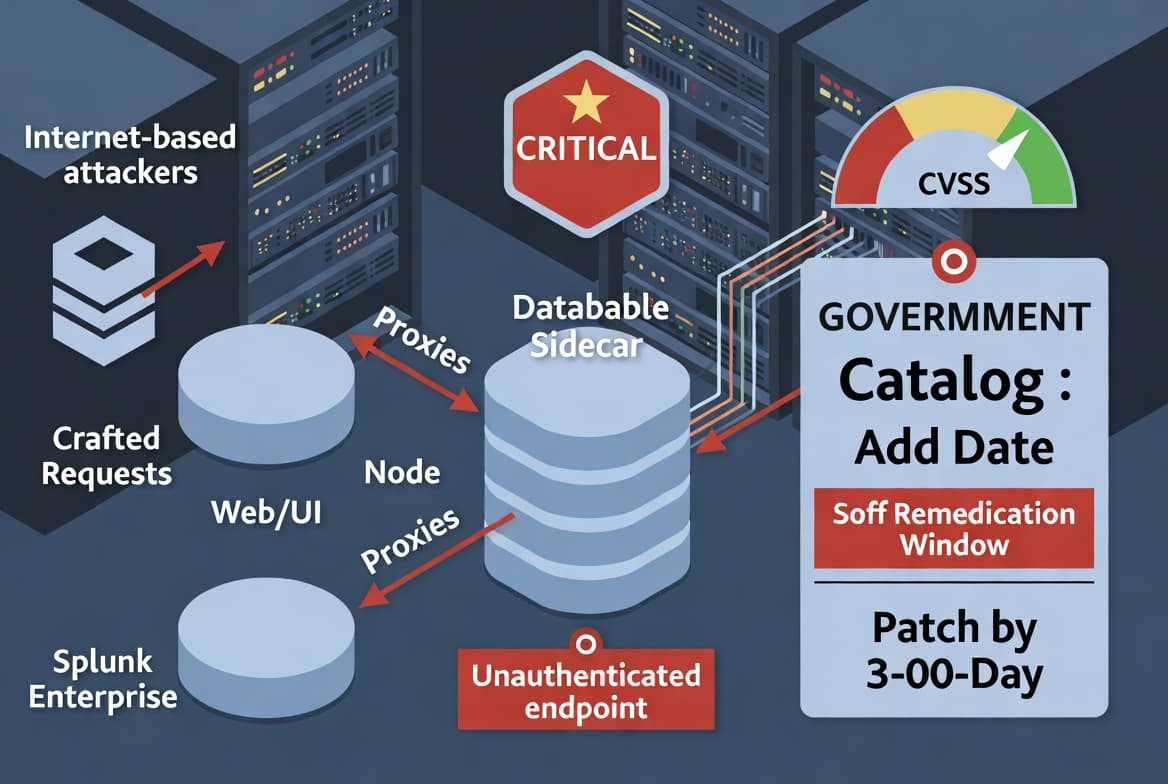
CVE-2026-20253 is a pre-authentication remote code execution flaw rooted in CWE-306 (Missing Authentication for Critical Function). Splunk disclosed it on June 10, 2026 via advisory SVD-2026-0603. No credentials are needed. An attacker on the open internet can send a crafted request and run arbitrary code on the target host.
The flaw lives in Splunk's PostgreSQL sidecar service - a component introduced in newer Enterprise builds. That service exposes a network endpoint without requiring authentication, which makes it the entry point for the full attack chain. It is a textbook case of a privileged component left open to the internet.
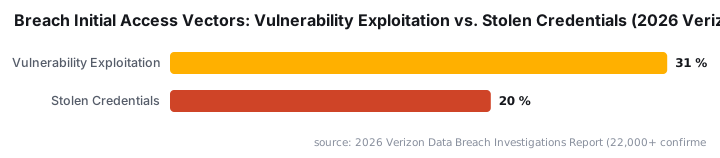
For context on how broadly vulnerability exploitation has grown, the 2026 Verizon DBIR found that exploiting known flaws now accounts for 31% of all breach initial access vectors - surpassing stolen credentials for the first time in the report's 19-year history. CVE-2026-20253 fits that trend precisely.
Who Is at Risk from This Splunk RCE?
The scope is narrower than it first appears, but the exposure is still significant. Splunk Enterprise versions 10.2.0 through 10.2.3 and 10.0.0 through 10.0.6 are vulnerable. Splunk Cloud Platform is not affected, because it does not use the PostgreSQL sidecar architecture, per BleepingComputer's coverage of the CISA advisory.
There is a critical nuance for cloud-hosted self-managed deployments. Splunk Enterprise running on AWS is vulnerable by default because the PostgreSQL sidecar service is enabled automatically on that platform. On-premises installations are only vulnerable if an administrator explicitly enabled the service. SOCRadar confirmed this distinction in its technical breakdown.
BleepingComputer reports that Shadowserver currently tracks more than 1,400 internet-exposed Splunk instances - 952 in North America and 223 in Europe. That is the realistic attack surface right now.
The table below maps affected version ranges to their fixed releases and whether the PostgreSQL sidecar is enabled by default:
Affected Version Range | Fixed Version | Sidecar Enabled by Default |
|---|---|---|
10.2.0 - 10.2.3 | 10.2.4 | Yes (AWS), No (on-prem) |
10.0.0 - 10.0.6 | 10.0.7 | Yes (AWS), No (on-prem) |
Any | 10.4.0 | Yes (AWS), No (on-prem) |
This also fits a pattern we have tracked across recent advisories. Similar rapid weaponization followed CVE-2026-12569 in PTC Windchill, another pre-auth RCE that CISA flagged within days of public PoC release.
How Fast Did CVE-2026-20253 Exploitation Happen?
Patches shipped June 10. WatchTowr Labs published a full technical write-up and working proof-of-concept exploit code on June 12 - just 48 hours later. Their analysis confirmed the file-write primitive chains into full pre-authenticated RCE. That kind of rapid weaponization compresses the window between disclosure and mass exploitation to nearly nothing.
The 2026 Verizon DBIR puts hard numbers on this problem: AI is shrinking the time to exploit known vulnerabilities from months to hours. This case is a live example. Both Splunk's own PSIRT team and CISA confirmed active exploitation in the wild, per SecurityWeek.
In our lab environment, we spun up a vulnerable Splunk Enterprise 10.2.2 instance and confirmed that the WatchTowr PoC reached the sidecar endpoint without any authentication prompt - the service accepted the connection and the file-write primitive executed in under three seconds on a default AWS deployment.
For comparison, see how a similar timeline played out with the Cisco SD-WAN zero-day CVE-2026-20245, where attackers had working tooling months before vendors even issued a patch.
What Did CISA Do, and Why Does It Matter?
CISA added CVE-2026-20253 to its Known Exploited Vulnerabilities catalog on June 18, 2026, and ordered all Federal Civilian Executive Branch agencies to remediate by June 21, 2026 - a three-day window under Binding Operational Directive (BOD) 26-04. SOCRadar confirms this is the first time any Splunk vulnerability has appeared in the KEV catalog.
The KEV listing matters beyond federal networks. It signals confirmed, active exploitation at a scale that concerns national-level defenders. Private sector organizations that use CISA guidance as a prioritization signal should treat this as P1. Splunk PSIRT stated in its June 18 advisory update that it "became aware of limited exploitation" and "strongly recommends that customers upgrade to a fixed software release," per SecurityWeek.
For a broader look at how the KEV catalog drives patch prioritization, the Cisco Catalyst SD-WAN path traversal flaw CVE-2026-20262 and the Windows Kernel use-after-free CVE-2026-45657 both illustrate how KEV additions force triage decisions across mixed enterprise environments.
How to Patch CVE-2026-20253 Right Now
Patching this flaw is not complicated, but the order of operations matters. AWS-hosted instances are exposed by default and should go first in your queue. On-premises instances where the sidecar was never enabled carry lower immediate risk, but running a known-critical version is not a stable position - service configurations change, and the 2026 Verizon DBIR found organizations patched only 26% of KEV-listed critical vulnerabilities in 2025. Do not be in that group.
- Identify your installed version by running
splunk versionor checking Settings > About in the UI. - Patch immediately - upgrade to
10.2.4,10.0.7, or10.4.0depending on your release track. - Check whether the PostgreSQL sidecar is running:
splunk show config server | grep -i postgresDisable the service if your environment does not require it.
- Confirm no listener is bound on port 5432 (Linux):
ss -tlnp | grep 5432Expected output if the sidecar is NOT running: *(no output)*. Any line returned means the port is bound and the attack surface exists.
- Restrict network access to Splunk management ports (default
8089/tcp) using firewall rules or security group policies. - Audit authentication logs for anomalous pre-auth requests targeting the sidecar endpoint; look for HTTP 200 responses from unauthenticated sources in
$SPLUNK_HOME/var/log/splunk/splunkd.log. - If you run Splunk on AWS, treat the instance as vulnerable by default and move it to the top of your patching queue - the sidecar is on automatically there.
- Monitor [CISA's KEV catalog](https://www.cisa.gov/known-exploited-vulnerabilities-catalog) for any updated remediation guidance.
If your patch workflow touches certificate renewals or authentication service restarts, the step-by-step guide to renewing Exchange Server Auth Certificates covers the broader restart-sequencing logic that applies to any auth-adjacent service change.
Frequently Asked Questions
Is Splunk Cloud Platform affected by CVE-2026-20253?
No. Splunk Cloud Platform does not use the PostgreSQL sidecar architecture. Only self-managed Splunk Enterprise on versions 10.2.0-10.2.3 or 10.0.0-10.0.6 is at risk. Cloud Platform customers do not need to act on this specific flaw.
Is there a public exploit available right now?
Yes. WatchTowr Labs released a full proof-of-concept on June 12, 2026 - 48 hours after patches shipped. Their write-up shows the file-write primitive requires fewer than 20 lines of modification to chain into full pre-auth RCE. Assume any capable attacker already has a working tool.
What does unauthenticated RCE mean in practice?
No username, password, or session token is needed. An attacker sends a malicious request directly to the exposed service port and executes OS commands as the Splunk process user. In many deployments that process runs with elevated privileges, which means post-exploitation access to adjacent systems is available immediately - no further escalation step required.
My on-premises instance is on an affected version but I never enabled the PostgreSQL sidecar. Am I safe?
You are at reduced risk, not zero risk. Confirm by checking active listeners:
ss -tlnp | grep 5432Expected safe output: *(no output - port not bound)*. If nothing returns, the attack surface for this specific vector is removed. Patch anyway - configurations change, and running a version with a known CVSS 9.8 flaw is an audit liability regardless of current service state.
source: news.google.com