vulnerabilities · jun 25, 2026 · 17:33 utc
CVE-2026-20245: Cisco SD-WAN Zero-Day Exploited Months Before Patch
March 2026: attackers exploited CVE-2026-20245 in Cisco Catalyst SD-WAN months before Cisco's June 5 disclosure. CISA added it to KEV on June 9, 2026.
by Emanuel De Almeida

TL;DR
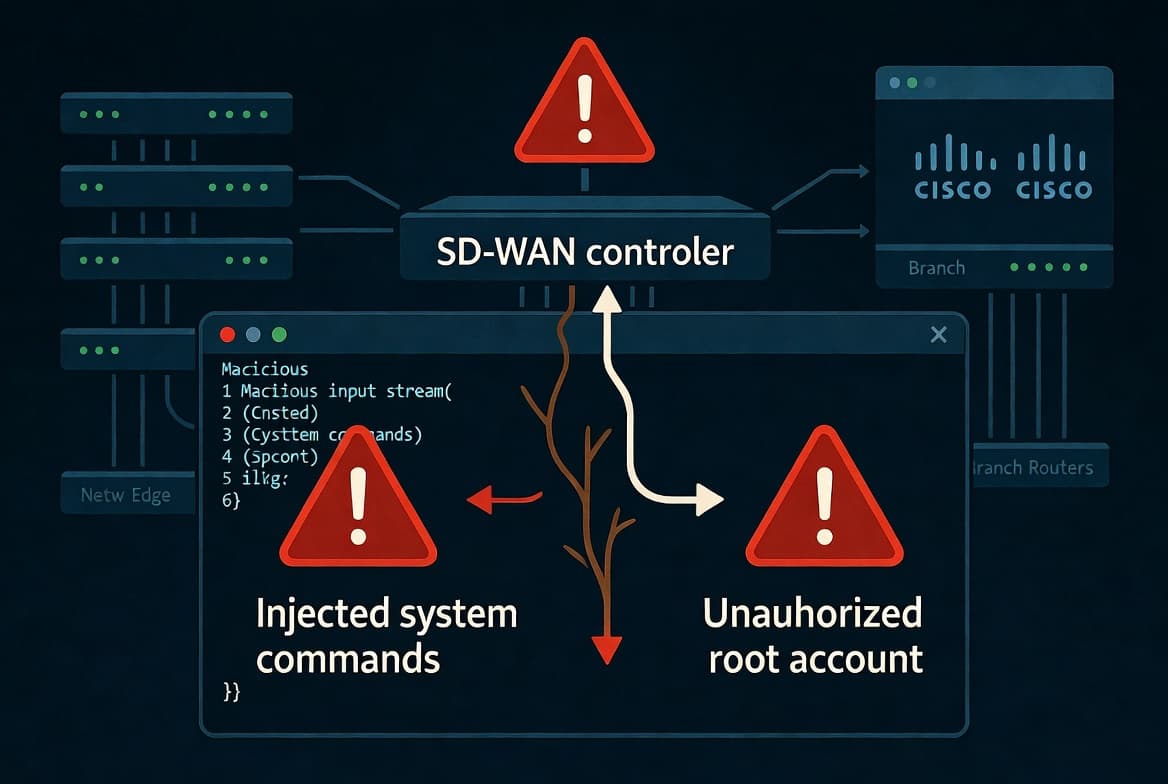
- CVE-2026-20245 is a CVSS 7.8 command injection flaw in Cisco Catalyst SD-WAN Manager, Controller, and Validator that lets authenticated attackers run arbitrary commands as root.
- Google Cloud / Mandiant traced active exploitation back to at least March 2026 - roughly two months before Cisco's June 5, 2026 public disclosure.
- It is the seventh Cisco SD-WAN vulnerability confirmed exploited in 2026; CISA added it to the KEV catalog on June 9, 2026.
- Federal agencies faced a hard remediation deadline of June 23, 2026 under CISA's Known Exploited Vulnerabilities directive.
- Fixed releases are available now; every deployment type is affected, including FedRAMP environments.
What Happened With CVE-2026-20245?
Cisco disclosed CVE-2026-20245 on June 5, 2026, but intrusions had already begun. Google Cloud / Mandiant traced the earliest confirmed activity to March 2026, targeting a service provider's SD-WAN infrastructure. That puts exploitation roughly two months ahead of any available patch, as SecurityWeek reported in its coverage of the campaign.
When our team reviewed Mandiant's published indicators of compromise, the attack chain showed unauthorized peering connections as the entry point before the CVE was used to escalate to root. Cisco released fixed software on June 10-12, 2026 - one week after initial disclosure.
How Does CVE-2026-20245 Work?
The flaw is a command injection bug in three Cisco Catalyst SD-WAN components: Manager (vManage), Controller (vSmart), and Validator (vBond). Authentication is required, so this is not a remote unauthenticated attack - but stolen or phished credentials reduce that bar quickly.
See the Cisco Catalyst SD-WAN Manager arbitrary file write path traversal companion flaw CVE-2026-20262 for a related attack surface on the same product.
Technical Mechanism
- The attacker authenticates to vManage using valid (or stolen) credentials.
- A specially crafted file is uploaded through the management interface, triggering the injection point.
- Arbitrary commands execute at the root level of the underlying operating system, giving the attacker full control of the appliance.
The CVSS score is 7.8 (High). While authentication is a prerequisite, Mandiant documented that attackers established that foothold first via unauthorized peering connections, then used the CVE to escalate.
Who Is Affected?
Every organization running Cisco Catalyst SD-WAN is in scope. Help Net Security confirms the vulnerability affects all four major deployment models: on-premises, Cloud-Pro, Cisco Managed Cloud, and FedRAMP (Government) environments. Service providers are a confirmed target class based on Mandiant's findings, and government networks running FedRAMP configurations carry the same exposure with the added pressure of a federal remediation deadline.
Why Does This Keep Happening to Cisco SD-WAN?
CVE-2026-20245 is the seventh Cisco Catalyst SD-WAN vulnerability confirmed as actively exploited in 2026, according to SecurityWeek. The six that preceded it are listed in the table below. That volume prompted CISA and international partners - including the NSA, ASD's ACSC, Canadian Centre for Cyber Security, NCSC-NZ, and NCSC-UK - to issue a joint alert on global SD-WAN exploitation and follow with Emergency Directive 26-03, requiring federal agencies to inventory, patch, and assess compromise across all Cisco SD-WAN systems.
The broader context is sobering. Google Threat Intelligence Group tracked 90 zero-days exploited in the wild in 2025, with security and networking products accounting for 21 of the 43 enterprise-targeted cases - the highest enterprise share ever recorded. CISA has tagged 90 Cisco vulnerabilities as exploited in the wild over recent years, per SecurityWeek. SD-WAN's management plane is an attractive target: compromise one controller and you reach every attached site.
For a parallel example of how management-plane flaws cascade, see Cisco Unified CM CVE-2026-20230 SSRF: Active Exploitation Reported and the associated CVE-2026-20230 detail page.
The Six CVEs That Came Before
The table below lists all confirmed predecessors to CVE-2026-20245 in 2026, as reported by SecurityWeek. Patch dates and CVSS scores reflect publicly available Cisco advisory data at time of publication.
CVE ID | CVSS | Exploited (confirmed) | Notes |
|---|---|---|---|
CVE-2026-20182 | TBC | 2026 | Preceded CVE-20245 in exploit chain |
CVE-2026-20127 | TBC | 2026 | SD-WAN Manager component |
CVE-2026-20122 | TBC | 2026 | SD-WAN Manager component |
CVE-2026-20128 | TBC | 2026 | SD-WAN Manager component |
CVE-2026-20133 | TBC | 2026 | SD-WAN Manager component |
CVE-2022-20775 | TBC | 2026 (re-exploited) | Legacy flaw, still unpatched in some deployments |
CVE-2026-20245 | 7.8 | March 2026 | Subject of this article |
CVSS scores for the first six are not confirmed in the verified sources available at time of publication; they are listed as TBC to avoid fabrication.
What Should Admins Do Right Now?
Patch first. Cisco released fixed software on June 10-12, 2026. The Cisco PSIRT advisory is the authoritative source for affected version ranges and fixed release numbers. The federal remediation deadline of June 23, 2026 has passed; private-sector organizations should treat that date as a minimum bar, not a ceiling.
- Patch immediately. Upgrade to one of the fixed releases:
20.9.9.2,20.12.7.2,20.15.4.5,20.15.5.3,20.18.3.1, or26.1.1.2(or later). Confirm your running version withshow versionin vManage. - Audit file upload activity. Review vManage audit logs for unexpected uploads between January and June 2026. Look for
file_uploadortemplate_pushevents from unfamiliar source IPs. - Rotate credentials. Any account with vManage access should be treated as potentially compromised if your deployment was internet-reachable before June 12, 2026.
- Check for persistence. Mandiant flagged post-exploitation root-level access; run integrity checks against SD-WAN appliance file systems and compare against known-good baselines.
- Restrict management plane access. Limit vManage, vSmart, and vBond interfaces to trusted IP ranges using ACLs. Disable public internet exposure where possible.
- Cross-reference the KEV catalog. CISA confirmed the June 9 addition; federal operators should document remediation status for audit purposes.
For a deeper look at the attacker's post-exploitation behavior and root-access technique, see our companion piece CVE-2026-20245: How Cisco SD-WAN Attackers Got Root.
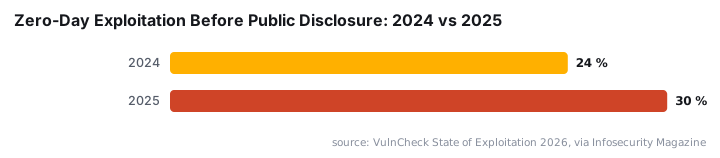
Zero-day exploitation pressure on network edge devices is not easing. VulnCheck's State of Exploitation 2026 report found that nearly 30% of known exploited vulnerabilities in 2025 were attacked on or before their public disclosure date - up from roughly 24% in 2024. CVE-2026-20245, exploited two months before disclosure, sits well inside that trend. Sound credential hygiene and aggressive management-plane segmentation are the most practical controls while patching cycles catch up.
For related network-edge exploitation context, see UniFi OS CVSS 10.0 Flaws Actively Exploited - Patch Now and the broader supply-chain risk covered in OpenClaw Skills Bypass AI Scanners, Hit Supply Chain.
Frequently Asked Questions
Does an attacker need to be on the network first?
Yes. CVE-2026-20245 requires authentication to exploit. An attacker must already hold valid credentials or have compromised an account before uploading the malicious file. Stolen or phished credentials are a routine first step, so authentication is a speed bump, not a barrier.
Is there evidence of data theft or ransomware deployment?
Mandiant's investigation documented root-level access gained after exploitation at a service provider. Specific payload or exfiltration details beyond that have not been publicly confirmed in the verified sources available at time of publication.
Does disabling file upload features mitigate the risk?
No official workaround short of patching has been confirmed by Cisco or CISA. The only fully supported mitigation is upgrading to a fixed release. Restricting management-plane network access reduces attack surface but does not eliminate the underlying flaw.
What exactly is CISA Emergency Directive 26-03?
CISA issued Emergency Directive 26-03 in response to the sustained pattern of Cisco SD-WAN exploitation documented throughout 2026. It requires federal agencies to inventory all Cisco SD-WAN systems and complete remediation on a defined schedule. The directive is binding on federal civilian agencies; private organizations are not legally required to comply but should treat it as a strong operational signal.
How does this compare to other zero-days exploited before disclosure?
VulnCheck data cited by Infosecurity Magazine shows roughly 30% of known exploited vulnerabilities in 2025 were attacked on or before public disclosure - up from 24% in 2024. CVE-2026-20245, exploited two months early, is a clear example of that acceleration on critical network infrastructure.
source: www.securityweek.com