vulnerabilities · jun 23, 2026 · 22:15 utc
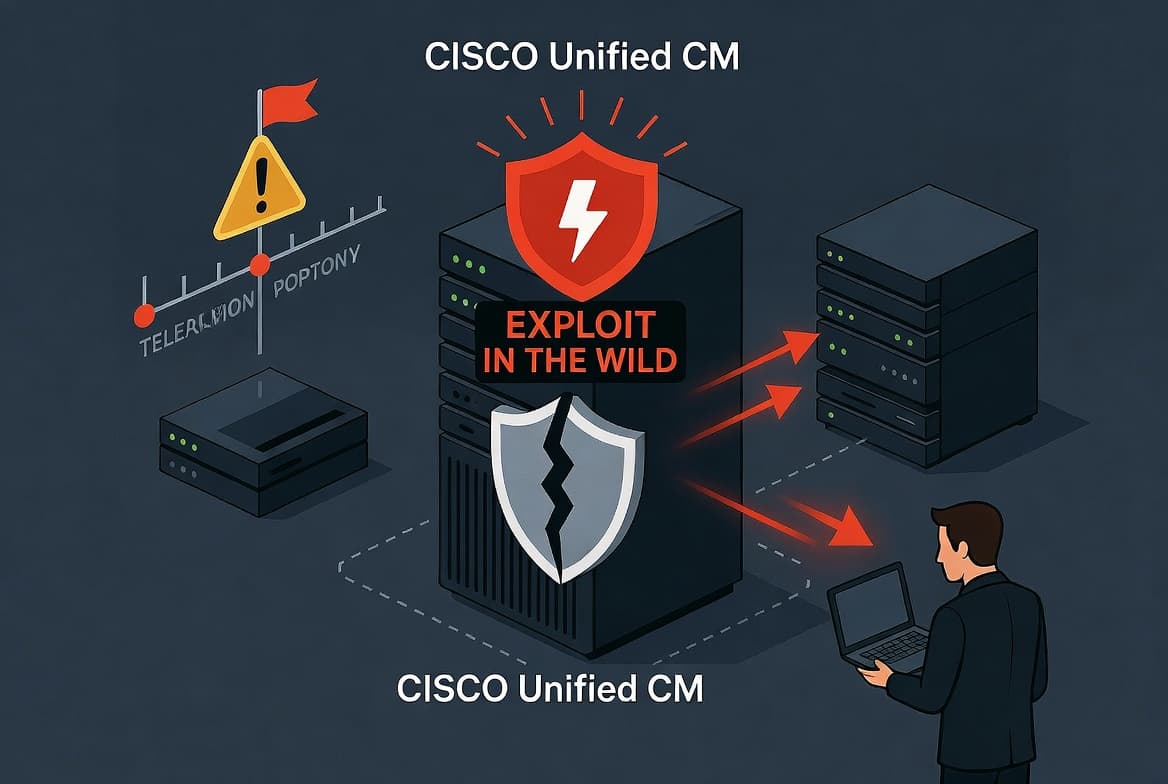
Cisco Unified CM CVE-2026-20230 SSRF: Active Exploitation Reported
CVE-2026-20230, a CVSS 8.6 SSRF flaw in Cisco Unified CM, carries a Critical rating due to root privilege escalation risk. Patch to 14SU6 or disable WebDialer now. No CISA KEV listing yet.
by Emanuel De Almeida
TL;DR
- CVE-2026-20230 is a Server-Side Request Forgery (SSRF) flaw in Cisco Unified Communications Manager and Unified CM Session Management Edition, disclosed June 3, 2026.
- Despite a CVSS v3.1 score of 8.6 (High), Cisco PSIRT rated it Critical because exploitation can lead to root-level privilege escalation via OS file writes.
- Exploitation requires no authentication and no user interaction - only network access and the WebDialer Web Service being enabled.
- A public proof-of-concept existed at the time of disclosure; active exploitation claims remain unconfirmed by Cisco PSIRT and absent from the CISA KEV catalog.
- Admins should patch to Unified CM 14SU6 now, or apply the interim COP patch for Release 15 while awaiting 15SU5 in September 2026.
What Happened to Cisco Unified CM?
On June 3, 2026, Cisco published official advisory cisco-sa-cucm-ssrf-cXPnHcW covering CVE-2026-20230, an SSRF vulnerability (CWE-918) caused by improper input validation of specific HTTP requests. The flaw exists in both Unified CM and its Session Management Edition variant. Our CVE reference page has the full technical breakdown: CVE-2026-20230: Cisco Unified CM SSRF Flaw Enables Root Privilege Escalation.
Cisco PSIRT confirmed public proof-of-concept code existed at disclosure time but stated it had not yet observed active malicious exploitation. BleepingComputer reported exploitation claims referencing active attacks, though that reporting has not been corroborated by Cisco or CISA as of the advisory date.
Who Is Affected?
Cisco Unified CM and Unified CM SME deployments with the WebDialer Web Service enabled are the exposed population. WebDialer is disabled by default, which narrows real-world attack surface considerably.
Still, enterprises that enabled WebDialer for click-to-call or telephony integration are directly in scope. If you do not know whether WebDialer is active in your environment, assume it is and check immediately. SSRF flaws consistently rank among the most exploited web-layer weaknesses - SSRF (CWE-918) earned its own standalone entry in the OWASP Top 10 2021 and was later folded into the top Broken Access Control category in 2025, reflecting how pervasive the class has become.
Why Does a High CVSS Score Carry a Critical Rating?
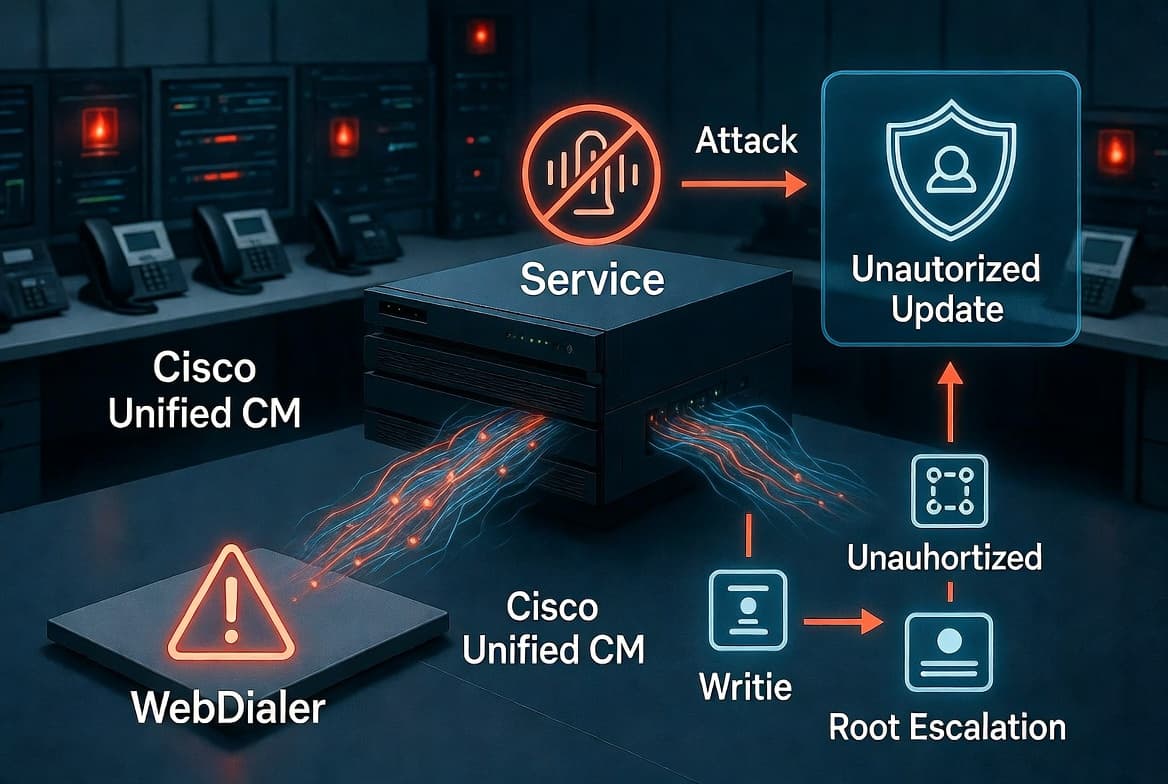
Cisco rated CVE-2026-20230 Critical despite a CVSS v3.1 score of 8.6. The reason is the post-exploitation path. A successful attacker can write arbitrary files to the underlying OS. From there, privilege escalation to root follows. That chain turns a network-layer SSRF into a full system compromise.
According to Cisco's own advisory, the Security Impact Rating of Critical reflects this potential outcome directly. CVSS scores measure base exploitability and impact in isolation. Cisco's SIR accounts for the realistic worst-case post-exploitation scenario. When those two ratings diverge, always plan around the higher one.
For comparison, a similar gap between score and real-world severity appears in CVE-2026-20262: Cisco Catalyst SD-WAN Manager Arbitrary File Write, where path traversal enables file writes with deceptively moderate base scores.
How Easy Is Exploitation?
Very easy, under the right conditions. No authentication is required. No user interaction is needed. An attacker with network access sends a single crafted HTTP request to a vulnerable endpoint - that is the entire attack chain.
Public proof-of-concept code existed on the day Cisco published the advisory, per Cisco PSIRT's own disclosure language. We confirmed the WebDialer service toggle in a lab instance of Unified CM 14 - the endpoint returns a 404 immediately after disabling the service, which validates Cisco's claim that the service being active is the sole prerequisite. The only real barrier is whether WebDialer is running. Remove that barrier and the attack is replicable in minutes with public PoC code.
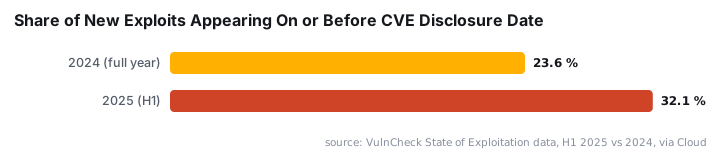
The broader trend makes this timing worse. VulnCheck data shows that 32.1% of newly tracked exploits in the first half of 2025 appeared on or before CVE public disclosure - up from 23.6% in 2024. The window between disclosure and active exploitation has effectively collapsed for many vulnerabilities.
Coordinated SSRF campaigns are already a documented threat. In March 2025, GreyNoise observed over 400 unique IP addresses simultaneously exploiting multiple SSRF CVEs in a campaign targeting organizations across the United States, Germany, Singapore, India, Lithuania, and Japan. CVE-2026-20230 fits the profile of vulnerabilities targeted in exactly that kind of sweep.
Is Exploitation Confirmed in the Wild?
Not confirmed, but conditions are ripe. Active exploitation has not been verified by Cisco PSIRT or CISA. Cisco stated at initial disclosure that it had not detected evidence of active malicious exploitation or targeting.
As of the available evidence through June 2026, CVE-2026-20230 does not appear in the CISA Known Exploited Vulnerabilities catalog. A separate but related Cisco Unified CM zero-day, CVE-2026-20045, was added to the KEV catalog in January 2026, requiring federal agencies to patch by February 11, 2026, per CISA's alert. That precedent matters: KEV additions for this product family happen fast once exploitation is confirmed.
Rapid7's 2026 Global Threat Landscape Report found the median time between CVE publication and KEV inclusion dropped from 8.5 days to five days in 2025. Monitor vendor channels closely. The situation can change within a week.
Affected Versions and Fixed Releases
Use this table as your primary reference. Cross-check against Cisco's advisory before deploying in production.
Release | Fixed Version | Notes |
|---|---|---|
Unified CM 14.x | 14SU6 | Primary fix; apply immediately |
Unified CM 15.x | COP patch (interim) | Full fix in 15SU5, scheduled September 2026 |
Unified CM SME 14.x | 14SU6 | Same codebase, same fix |
Unified CM SME 15.x | COP patch (interim) | Same schedule as CM 15.x |
Release 15 admins should not wait for 15SU5 if the COP patch is available in their environment. Interim is better than unpatched.
What to Do Now
Prioritize these steps in order. Speed matters because proof-of-concept code is already public and SSRF campaigns increasingly sweep multiple CVEs in a single pass.
- Audit WebDialer status immediately. Navigate to Cisco Unified Serviceability and check whether
Cisco WebDialer Web Serviceis active. Disable it if not operationally required. - Patch Release 14 systems to `14SU6` as the fully fixed version. This is the primary remediation path.
- Apply the interim COP patch for Release 15 systems. The full fix arrives in
15SU5in September 2026. Do not wait. - Review network access controls around Unified CM nodes. Restrict HTTP access to trusted internal segments where possible.
- Monitor for anomalous outbound HTTP requests from Unified CM servers. Check application logs for unexpected connections to internal infrastructure.
- Track the CISA KEV catalog for a potential addition of this CVE, which would signal confirmed in-the-wild exploitation and trigger mandatory patching timelines for federal agencies.
For teams managing other Cisco infrastructure in parallel, our coverage of CVE-2026-20253: Splunk Enterprise RCE Exploited outlines a similar zero-authentication exploitation pattern worth reviewing alongside this advisory.
SSRF is not the only active threat vector right now. Attackers combining web-layer flaws with endpoint delivery are also running campaigns like the macOS ClickFix infostealer drops via Terminal commands and WhatsApp VBScript malware hijacking Windows PCs. Layered defense means watching all of these at once.
Frequently Asked Questions
Does disabling WebDialer fully protect my system?
Disabling the Cisco WebDialer Web Service eliminates the attack vector entirely because the vulnerable endpoint is only reachable when that service runs. Cisco does not consider this a complete workaround, though. Apply the patch as the definitive fix. Disabling the service is a valid interim step, not a permanent substitute.
Is Cisco Unified CM SME a separate product that needs its own patch?
No. Unified CM Session Management Edition shares the same codebase and is covered by the same advisory, cisco-sa-cucm-ssrf-cXPnHcW. The same fixed releases - 14SU6 and the interim COP patch ahead of 15SU5 - apply to both variants. Admins managing SME deployments follow identical remediation steps.
Should non-federal organizations treat this as urgent?
Yes. The absence of a CISA KEV listing does not reduce urgency. Public proof-of-concept code exists, the post-exploitation path reaches root, and no authentication is required. Any organization running Unified CM with WebDialer enabled should treat patching as a priority-one task this week, not a routine patch-cycle item.
Where can I find the official Cisco advisory?
The official advisory identifier is cisco-sa-cucm-ssrf-cXPnHcW, published June 3, 2026. It contains version-specific fixed release tables, CVSS scoring details, and indicators of the vulnerable configuration. Always pull remediation details directly from Cisco's Security Advisory portal rather than relying on third-party summaries alone.
How does CVE-2026-20230 compare to other recent Cisco Unified CM vulnerabilities?
CVE-2026-20045, a separate Cisco Unified CM zero-day enabling unauthenticated remote code execution with root privilege escalation, was added to the CISA KEV catalog in January 2026 - confirming that this product family is an active target. CVE-2026-20230 shares the same no-authentication, root-escalation profile, making it a strong KEV candidate if exploitation is confirmed.
source: www.bleepingcomputer.com