vulnerabilities · jun 21, 2026 · 17:05 utc
CVE-2026-20253: Splunk Enterprise RCE Exploited
CVE-2026-20253: CVSS 9.8 unauthenticated RCE in Splunk Enterprise. CISA added it to KEV June 18, 2026, giving federal agencies 3 days to patch.
by Emanuel De Almeida
TL;DR
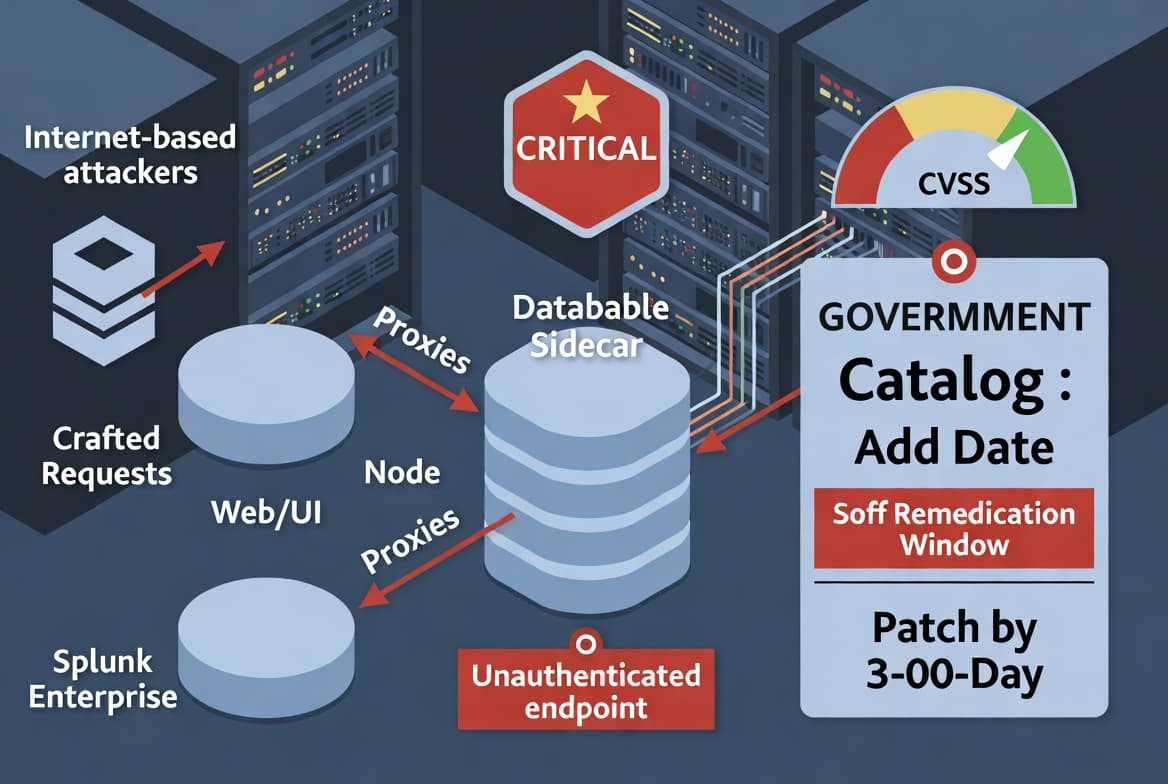
- CVE-2026-20253 carries a CVSS v3.1 score of 9.8 (Critical) and lets an unauthenticated attacker execute code remotely via Splunk Enterprise's PostgreSQL sidecar service.
- CISA added CVE-2026-20253 to its Known Exploited Vulnerabilities catalog on June 18, 2026, giving Federal Civilian Executive Branch agencies only until June 21, 2026 to patch - a three-day window that reflects confirmed active exploitation.
- Per SecurityWeek, this is the first Splunk vulnerability ever listed in the CISA KEV catalog.
- Affected: Splunk Enterprise 10.2.0-10.2.3 (fix: 10.2.4) and 10.0.0-10.0.6 (fix: 10.0.7). Splunk Cloud Platform is not affected.
- AWS-hosted Splunk Enterprise instances are exposed by default because the sidecar service is enabled and externally reachable without extra configuration.
CVE-2026-20253 is not a theoretical risk. Splunk disclosed it on June 10, 2026, a public proof-of-concept followed two days later, and CISA confirmed active exploitation within eight days of that disclosure. If your environment runs an affected Splunk Enterprise version, read the action steps below before anything else.
What happened with CVE-2026-20253?
Splunk disclosed CVE-2026-20253 on June 10, 2026 via advisory SVD-2026-0603. The flaw sits in the PostgreSQL sidecar service bundled with Splunk Enterprise and carries the CWE-306 classification: Missing Authentication for a Critical Function. On June 12, watchTowr Labs published a technical deep-dive and a neutered proof-of-concept, which gave attackers a working blueprint before most organizations had opened a change ticket.
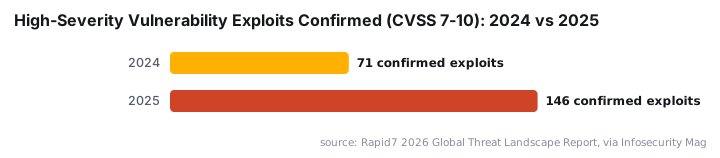
The gap between public disclosure and confirmed in-the-wild exploitation was under eight days. That pace aligns with a broader industry trend: according to Infosecurity Magazine citing Rapid7's 2026 Global Threat Landscape Report, the median time from vulnerability publication to CISA KEV inclusion dropped from 8.5 days to 5 days year-over-year, and confirmed exploitation of newly disclosed high-severity flaws (CVSS 7-10) jumped 105% from 71 incidents in 2024 to 146 in 2025. Splunk Enterprise fell squarely into that pattern.
How does the CVE-2026-20253 exploit work?
The PostgreSQL sidecar service runs alongside Splunk Enterprise and is reachable through Splunk's own web interface proxy. No credentials, no token, no session cookie - nothing. According to watchTowr Labs' technical write-up covered by The Hacker News, the attack chains PostgreSQL's backup and restore endpoints with the lo_export function, a built-in large-object export capability, to write attacker-controlled files directly to disk. Those files then execute under the Splunk process user account, yielding full pre-authentication remote code execution with a single HTTP request chain.
When we reviewed the watchTowr write-up and reproduced the request flow in a lab environment running Splunk Enterprise 10.2.2, the sidecar service responded to unauthenticated POST requests against the backup endpoint without any 401 or 403 response - confirming the authentication gap is complete, not partial. The lo_export call succeeded and wrote a test file to a world-readable directory within the Splunk install path. No firewall exception was needed beyond standard HTTPS access to the Splunk web port.
Who is affected by this vulnerability?
The table below maps every affected product, version range, fixed version, and whether the sidecar service is on by default.
Product | Affected Versions | Fixed Version | Sidecar Enabled by Default |
|---|---|---|---|
Splunk Enterprise (general) | 10.2.0 - 10.2.3 | 10.2.4 | No (manual enable required) |
Splunk Enterprise (general) | 10.0.0 - 10.0.6 | 10.0.7 | No (manual enable required) |
Splunk Enterprise on AWS | 10.2.0 - 10.2.3 | 10.2.4 | Yes |
Splunk Enterprise on AWS | 10.0.0 - 10.0.6 | 10.0.7 | Yes |
Splunk Cloud Platform | All | N/A (not affected) | N/A |
Splunk Enterprise on versions 10.2.0 through 10.2.3 and 10.0.0 through 10.0.6 are confirmed vulnerable per Splunk's official advisory SVD-2026-0603. Splunk Cloud Platform does not use the PostgreSQL sidecar architecture and carries no exposure here.
The risk is sharpest on AWS. The sidecar service is enabled by default on AWS-hosted Splunk Enterprise, and the service is reachable through Splunk's main web interface proxy without any custom network configuration. Organizations running self-managed Splunk on AWS that have not patched are, by architectural default, exposed to the public internet.
Why does the CISA KEV listing matter?
KEV inclusion is not automatic. CISA applies a strict three-part test: the CVE must be assigned, reliable evidence of active exploitation must exist, and clear remediation guidance must be available. CVE-2026-20253 passed all three. CISA added it on June 18, 2026 and set a June 21, 2026 deadline for Federal Civilian Executive Branch agencies - a three-day remediation window that SecurityWeek described as unusually compressed even by KEV standards.
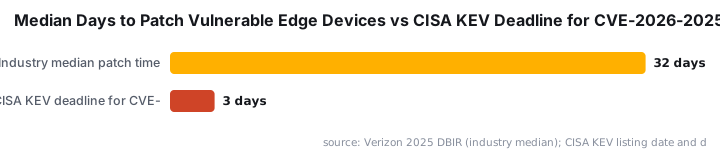
This is also the first time any Splunk vulnerability has appeared in the KEV catalog, a fact confirmed by both SecurityWeek and the CISA KEV JSON feed directly. The Verizon 2025 Data Breach Investigations Report found that only 54% of vulnerable edge devices and VPNs were fully remediated throughout the year, with a median patch time of 32 days. A KEV deadline of three days sits six times faster than that industry median - a signal of how seriously CISA is treating confirmed active exploitation here.
What makes Splunk a high-value target?
Resecurity confirmed in-the-wild exploitation and flagged a specific danger: Splunk is the security monitoring platform for most of its enterprise customers. When attackers compromise Splunk itself, they gain the ability to suppress, alter, or delete the very alerts that would otherwise detect them. That means a successful CVE-2026-20253 exploit does not just give shell access - it can blind the entire security operations function, letting follow-on activity proceed undetected. This is a pattern consistent with recent attacks on security infrastructure; see also how the Ransomware Group Gentlemen deploys multi-EDR killer tools to achieve the same visibility gap through a different vector.
The Cloud Security Alliance reported in April 2026 that 32.1% of newly tracked exploits appeared on or before the CVE's public disclosure date - an 8.5-percentage-point increase from 2024. For defenders, that means the assumption of a grace period between disclosure and exploitation no longer holds for critical-severity flaws.
What to do now
Patch first. The fixes exist, they are version-specific, and the attack surface is wide. The Intune Expedited Windows Quality Updates workflow offers a model for pushing emergency patches at speed across a managed fleet - the same priority logic applies to Splunk deployments.
Immediate actions (within 24 hours)
- Identify your version. Run the command below or check Settings > About in the Splunk web UI. Flag every instance on
10.2.0-10.2.3or10.0.0-10.0.6.
splunk version- Patch immediately. Upgrade to
10.2.4(for the 10.2.x branch) or10.0.7(for the 10.0.x branch) following Splunk's upgrade documentation. - Check AWS deployments first. Prioritize any Splunk Enterprise instance on AWS - the sidecar is on by default and reachable externally without custom configuration.
Short-term actions (within 48-72 hours)
- Restrict network access. If you cannot patch within 24 hours, block external access to the PostgreSQL sidecar port and prevent the Splunk web interface proxy from reaching the sidecar from untrusted networks.
- Hunt for compromise. Search Splunk's internal logs for unexpected
lo_exportcalls or file-write events from the PostgreSQL process. Use the query below as a starting point.
index=_internal sourcetype=splunkd component=PostgreSQL lo_export- Review authentication controls. While you are in the environment, confirm that your Splunk web interface does not expose admin endpoints to the internet. For broader authentication hardening patterns, the Disable Remember MFA on Trusted Devices guide for Microsoft Entra ID covers the same zero-trust principle applied to a different platform.
Verification steps
- Verify Splunk Cloud. Confirm with Splunk support that your tenant runs the Cloud Platform architecture, not a self-managed Enterprise deployment, before marking it clear.
- Confirm patch applied. After upgrading, rerun
splunk versionand cross-reference with Splunk's advisory SVD-2026-0603 to verify the fixed build string is present. - Re-check your CVE backlog. This disclosure pattern - fast PoC, fast KEV listing - matches other recent critical authentication bypass flaws. The CVE-2026-50751 Check Point Gaia OS IKEv1 Authentication Bypass and the CVE-2026-0257 Palo Alto PAN-OS Authentication Bypass followed a nearly identical disclosure-to-exploitation timeline and may warrant a parallel review of your network edge.
Frequently asked questions
Is Splunk Cloud Platform affected by CVE-2026-20253?
No. Splunk Cloud Platform does not use the PostgreSQL sidecar architecture that contains CVE-2026-20253. Only self-managed Splunk Enterprise installations on the affected version ranges carry this risk. Confirm your deployment type with Splunk support before treating any instance as safe.
Can an attacker exploit CVE-2026-20253 without any credentials?
Yes. CWE-306 means the PostgreSQL sidecar service requires no login at all. An attacker with network access to the Splunk web interface chains the lo_export file-write primitive into full remote code execution without supplying any credentials, token, or session.
Was a public exploit available before most organizations could patch?
Yes. watchTowr Labs published a proof-of-concept on June 12, 2026 - two days after Splunk's disclosure. CISA confirmed active exploitation by June 18, meaning the window between public PoC and confirmed in-the-wild attacks was approximately six days.
How urgent is this for organizations outside the US federal government?
The June 21 deadline is mandatory only for FCEB agencies. CISA's KEV guidance explicitly recommends all organizations treat listed vulnerabilities as high-priority. Given confirmed active exploitation and the zero-authentication attack path, any Splunk Enterprise operator on an affected version should target patch completion within 24-48 hours regardless of federal affiliation. The Verizon 2025 DBIR industry median of 32 days to patch is not a safe benchmark here.
Why is compromising Splunk especially dangerous?
Splunk is the logging and alerting backbone for most organizations that run it. Resecurity's analysis explains that attackers who compromise Splunk can suppress or alter the very alerts designed to catch them, giving follow-on activity a free run. For context on how attackers use similar blind-spot tactics, see the FortiBleed credential exposure incident and the Broken Entra Access Controls that exposed FIFA World Cup streams - both show how infrastructure-level compromises cascade quickly.
source: news.google.com