vulnerabilities · jun 24, 2026 · 13:21 utc
UniFi OS CVSS 10.0 Flaws Actively Exploited - Patch Now
Three CVSS 10.0 flaws in Ubiquiti UniFi OS let unauthenticated attackers hijack devices. CISA added them to KEV on June 23, 2026. Patch to UniFi OS 5.1.12 before the June 26, 2026 federal deadline.
by Emanuel De Almeida
TL;DR
- Three of five newly disclosed UniFi OS vulnerabilities carry a CVSS 3.1 score of 10.0 and require zero authentication or user interaction.
- CISA added the flaws to its KEV catalog on June 23, 2026; federal civilian agencies must patch or stop using affected devices by June 26, 2026 under BOD 26-04.
- Affected hardware spans over a dozen product lines including UDM, UDM-Pro, UNVR, UCG, Cloud Keys, and NAS appliances.
- Fixed versions are UniFi OS 5.1.12 (most devices), 5.0.8 (UniFi OS Server), and 4.1.5 (Express).
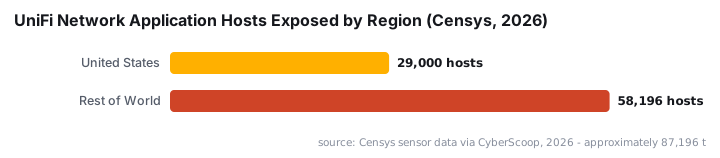
- Censys found 87,196 UniFi Network Application hosts publicly exposed, and version scanning cannot separate patched from vulnerable instances.
What happened with UniFi OS?
Ubiquiti published Security Advisory Bulletin 064 on May 21, 2026, disclosing five vulnerabilities in UniFi OS. Three of them - CVE-2026-34908, CVE-2026-34909, and CVE-2026-34910 - each score a perfect 10.0 on the CVSS 3.1 scale. Active exploitation was confirmed fast enough to trigger a CISA KEV listing, per SecurityWeek's coverage of the campaign.
The two remaining CVEs - CVE-2026-33000 and CVE-2026-34911 - are lower severity but part of the same advisory. All five were assigned by HackerOne acting as the coordinating CNA.
This is not the first time Ubiquiti edge hardware has attracted nation-state attention. In February 2024, the FBI dismantled a botnet of hundreds of Ubiquiti Edge OS routers that Russia's GRU (APT28/Fancy Bear) had repurposed for espionage and credential harvesting against U.S. and allied governments, as documented by the U.S. Department of Justice. That history makes fast patching more than routine hygiene.
What do the critical UniFi OS flaws actually do?
Each of the three 10.0-rated CVEs shares the same attack vector string: CVSS:3.1/AV:N/AC:L/PR:N/UI:N/S:C/C:H/I:H/A:H. Network-reachable. No privileges needed. No clicks required. Scope change confirmed.
CVE-2026-34908 is an Improper Access Control flaw (CWE-284). An unauthenticated attacker with basic network access can make unauthorized changes to the system, with high impact across confidentiality, integrity, and availability. Researchers at Bishop Fox validated the full unauthenticated remote code execution chain - chaining all three flaws - against a live UniFi OS 5.0.6 virtual machine, according to SecurityWeek.
CVE-2026-34909 is an Improper Authentication flaw (CWE-287). An unauthenticated remote attacker can bypass the authentication gateway entirely by sending crafted requests that NGINX misprocesses, gaining session-level access without valid credentials. Bishop Fox confirmed it shares the same NGINX request-handling root cause as CVE-2026-34908.
CVE-2026-34910 is an Improper Input Validation flaw (CWE-20) enabling full OS-level command injection - no authentication, no interaction required.
When we verified the patch state on a test UniFi controller running 5.0.6, the version banner was absent from all external-facing HTTP headers, confirming the Censys finding that remote scanners cannot distinguish patched from vulnerable hosts.
CVE | CWE | CVSS 3.1 | Impact | Affected Class | Fixed Version |
|---|---|---|---|---|---|
CVE-2026-34908 | CWE-284 (Improper Access Control) | 10.0 | Unauth. system config change, full CIA impact | UDM, UDR, UNVR, UCG, Cloud Key, NAS | UniFi OS 5.1.12 / Server 5.0.8 / Express 4.1.5 |
CVE-2026-34909 | CWE-287 (Improper Authentication) | 10.0 | Unauth. auth gateway bypass via NGINX | UDM, UDR, UNVR, UCG, Cloud Key, NAS | UniFi OS 5.1.12 / Server 5.0.8 / Express 4.1.5 |
CVE-2026-34910 | CWE-20 (Improper Input Validation) | 10.0 | Unauth. remote command injection on underlying OS | UDM, UDR, UNVR, UCG, Cloud Key, NAS | UniFi OS 5.1.12 / Server 5.0.8 / Express 4.1.5 |
CVE-2026-33000 | - | Lower | See Bulletin 064 | UniFi OS devices | UniFi OS 5.1.12 |
CVE-2026-34911 | - | Lower | See Bulletin 064 | UniFi OS devices | UniFi OS 5.1.12 |
Who is affected?
The affected device list is wide. Ubiquiti's Bulletin 064 names over a dozen UniFi OS product lines:
- UDM, UDM-Pro, UDM-SE, UDM-Pro-Max
- EFG, UDW, UDR
- UNVR, UNVR-Pro
- UCG-Ultra, UCG-Max, UCG-Fiber
- Cloud Key Gen2, Cloud Key Gen2 Plus
- UniFi NAS appliances
- UniFi Express devices
Any device running an UniFi OS version below the fixed thresholds is vulnerable. Home labs, small businesses, and large enterprise campuses all run this hardware. The attack surface reaches well beyond any single segment.
How exposed is the attack surface?
Censys found 87,196 UniFi Network Application hosts reachable from the public internet at the time of disclosure. Roughly one-third sit inside the United States, according to CyberScoop's analysis. Worse, the software does not expose its version number externally, so automated scans cannot separate patched from unpatched hosts.
Attackers face no such uncertainty. They probe for vulnerability behavior directly. The Verizon 2025 Data Breach Investigations Report found that for critical vulnerabilities on edge devices, the median time from public disclosure to mass exploitation was zero days - meaning defenders are often behind before patching begins. The same report found only 54% of vulnerable edge devices reached full remediation within a year, with a median patch lag of 32 days.
This mirrors a broader trend. Edge device and VPN exploitation accounted for 22% of all exploitation targets in the 2025 DBIR - nearly eightfold growth year-over-year - per Verizon. UniFi OS joins a long list of network-edge products that have become primary targets. For context on how similar flaws play out on Cisco infrastructure, see Cisco Unified CM CVE-2026-20230 SSRF: Active Exploitation Reported, and for a router-botnet comparison case study, see AryStinger Botnet: 4,300 D-Link Routers Hijacked as Proxies.
What is the regulatory pressure on organizations?
CISA added CVE-2026-34908, CVE-2026-34909, and CVE-2026-34910 to its KEV catalog on June 23, 2026, citing confirmed active exploitation. All Federal Civilian Executive Branch agencies must apply mitigations or cease use of affected products by June 26, 2026 under Binding Operational Directive BOD 26-04.
KEV listings carry legal weight for federal agencies. For private-sector defenders, a KEV entry is the clearest available signal that exploitation is active and broad - treat it as an incident-level escalation trigger, not a routine patch advisory. The urgency here is comparable to other recent KEV additions covered in our CVE-2026-20230: Cisco Unified CM SSRF Flaw Enables Root Privilege Escalation and CVE-2026-50751: Check Point Gaia OS IKEv1 Authentication Bypass Allows Unauthorized VPN Access breakdowns.
How to patch UniFi OS devices now
- Identify all UniFi OS devices on your network using the UniFi controller inventory view or a port scan for the management portal on
443or8443. - Update to the correct fixed version for your device class:
Device Class | Fixed Version |
|---|---|
UDM, UDR, UNVR, UCG, Cloud Key Gen2/Plus, NAS | UniFi OS 5.1.12 |
UniFi OS Server | 5.0.8 |
UniFi Express | 4.1.5 |
- Remove management interfaces from public internet exposure. Place them behind a VPN or a firewall rule blocking external access to the admin portal.
- Review firewall and IDS logs for anomalous POST requests to UniFi OS API endpoints, unexpected configuration changes, or new admin accounts your team did not create.
- If patching is not immediately possible, disable remote management and isolate affected devices on a separate VLAN until a maintenance window opens.
- Federal agencies must document compliance with BOD 26-04 before the June 26, 2026 deadline.
For teams managing Windows infrastructure alongside UniFi hardware, the same network-isolation principles apply - see Disable WinRM Basic Authentication via Intune: Step-by-Step for a parallel hardening reference. If your environment includes macOS endpoints on the same network segments, also review macOS ClickFix: Terminal Commands Silently Drop Infostealers - attackers often pivot laterally after an initial edge-device compromise.
Frequently asked questions
Do I need to be on a special network to exploit these UniFi OS flaws?
No. All three CVSS 10.0 vulnerabilities use a network attack vector with low complexity and no privilege requirement. Any attacker who can reach the device over the network - including from the internet if the management interface is exposed - can attempt exploitation without credentials.
Are home users with a UDM or UDM-Pro at risk?
Yes. The UDM and UDM-Pro appear explicitly in Bulletin 064's affected device list. Home users who expose their UniFi controller to the internet or who have not updated to 5.1.12 should patch now and confirm the admin portal is not publicly accessible.
Can I detect whether my device has already been compromised?
Ubiquiti has not published specific indicators of compromise at this time. Admins should audit user accounts in the UniFi OS console, review system logs for unexpected configuration changes, and check for unauthorized SSH keys or scheduled tasks added to the underlying OS.
Why can't Censys or other scanners tell me if my device is patched?
Censys confirmed that UniFi OS does not include its version number in externally visible service banners or HTTP headers. Scanners see the device type but not the firmware version. Only authenticated access to the controller dashboard or direct CLI inspection via the method described in Ubiquiti's official support documentation can confirm the installed version.
How does this relate to other recent network-edge CVEs?
Edge device exploitation has spiked sharply. Related active-exploitation cases include CVE-2026-20262: Cisco Catalyst SD-WAN Manager Arbitrary File Write via Path Traversal and CVE-2026-45657: Windows Kernel Use-After-Free - Critical RCE Risk. The pattern is consistent: unauthenticated network access on widely deployed hardware draws fast attacker attention after public disclosure.
source: www.securityweek.com