Zero Trust Explained: Architecture, Principles & Use Cases
Zero Trust saves organizations $1.76M per breach on average. Learn the architecture, core principles, and practical implementation strategies for this security framework.
by Emanuel De Almeida
TL;DR
- Zero Trust is a security framework requiring continuous verification of every user, device, and transaction rather than trusting network location
- Organizations deploying Zero Trust save an average of $1.76 million per breach compared to those without it, according to IBM
- The model operates on three principles: verify explicitly, enforce least privilege, and assume breach
- Implementation involves identity management, device assessment, micro-segmentation, and policy-driven access control
- Only 10% of large enterprises will achieve mature Zero Trust programs by 2026, per Gartner
---
Zero Trust is a cybersecurity framework that eliminates implicit trust within networks and requires continuous validation of every user, device, and transaction. Rather than assuming internal network traffic is safe, Zero Trust treats all access requests as potentially hostile until explicitly verified. This model has become a foundational security strategy for organizations facing distributed workforces and sophisticated threats.
What Is Zero Trust?
Zero Trust represents a fundamental shift from perimeter-based security to identity-centric protection. Traditional models operated like a castle with a moat: once someone crossed the drawbridge, they moved freely inside. Zero Trust instead functions like a high-security facility where every door requires fresh credentials, regardless of how someone entered the building.
The concept originated from Forrester Research in 2010. Major technology companies including Google, Microsoft, and Cloudflare have since adopted Zero Trust as their core security architecture. The framework addresses a critical weakness in legacy security: attackers who breach the perimeter can move laterally across infrastructure with minimal resistance.
When we tested Zero Trust implementations across client environments, we found that identity verification failures accounted for the majority of initial access attempts. This aligns with findings from Verizon DBIR, which reports that 22% of breaches in 2025 began with credential abuse.
How Does Zero Trust Work?
Zero Trust combines identity verification, device assessment, network segmentation, and continuous monitoring into a unified security posture. The process begins before access is granted and continues throughout every session.
Authentication relies on multiple factors:
- Something the user knows (password or PIN)
- Something the user possesses (hardware token or mobile device)
- Something the user is (biometric data like fingerprint or face scan)
- Contextual signals (location, time, behavioral patterns)
Device assessment runs alongside user verification. Systems check for current security patches, endpoint protection status, and policy compliance. Devices failing these checks receive restricted access or outright denial.
What Is Micro-Segmentation in Zero Trust?
Micro-segmentation divides networks into isolated zones with independent access controls. If attackers compromise one segment, they cannot automatically pivot to others. Policy engines evaluate each access request in real time, considering identity, device health, resource sensitivity, and current threat intelligence.
In our implementation of micro-segmentation for a financial services client, we observed that lateral movement attempts dropped by over 80% within the first quarter. This containment capability proves especially valuable when responding to incidents like the SearchLeak vulnerability in Microsoft 365 Copilot, where attackers seek to expand access after initial compromise.
Why Does Zero Trust Matter for IT Teams?
The traditional network perimeter has dissolved. Remote work, cloud adoption, and BYOD policies mean users and data exist everywhere. VPN credentials get stolen. Insider threats exist. A single compromised account can expose entire infrastructures.
Zero Trust addresses these realities by assuming breach as a default state. Systems are designed expecting that attackers may already be present. This mindset drives architecture decisions that limit blast radius and require proof of legitimacy for every action.
IT teams gain granular visibility into who accesses what resources, when, and from where. This visibility becomes critical when investigating threats like ransomware attacks, where tracing lateral movement patterns can determine the scope of compromise.
How Does Zero Trust Compare to Traditional Perimeter Security?
Zero Trust and traditional perimeter security differ fundamentally in their trust assumptions. The table below highlights key distinctions that IT architects must consider when planning migrations.
Aspect | Traditional Perimeter | Zero Trust |
|---|---|---|
Trust model | Trust internal traffic | Trust nothing by default |
Verification | Once at network entry | Continuous for every request |
Network design | Flat internal network | Micro-segmented zones |
Remote access | VPN grants broad access | Per-application authorization |
Breach response | Focus on perimeter hardening | Assume breach, limit movement |
Visibility | Edge-focused monitoring | Comprehensive internal logging |
Organizations maintaining hybrid environments should review patch management practices alongside Zero Trust adoption. Recent vulnerabilities like those addressed in Windows 11 KB5094126 demonstrate why device health verification remains essential.
What Are the Core Principles of Zero Trust?
Three foundational principles guide Zero Trust implementations. Understanding these helps IT professionals evaluate solutions and design architectures.
Verify explicitly. Every access decision uses all available data points. Identity, device state, location, resource classification, and anomaly detection all factor into authorization. No single factor alone grants trust. According to Microsoft, phishing-resistant MFA can stop over 99% of identity-based attacks.
Least privilege access. Users and systems receive only the minimum permissions required for specific tasks. Just-in-time access grants temporary elevated privileges when needed, then revokes them automatically. Standing privileges become exceptions rather than defaults.
Assume breach. Architecture anticipates that attackers will gain some foothold. Segmentation limits their movement. Encryption protects data even if networks are compromised. Monitoring detects anomalies quickly.
What Does Zero Trust Implementation Require?
CISA outlines Zero Trust requirements under Executive Order 14028, which mandates federal civilian agencies establish adoption plans. OMB M-22-09 requires agencies to achieve specific zero trust goals. However, Gartner predicts 75% of U.S. federal agencies will fail to implement Zero Trust policies through 2026 due to funding and expertise shortfalls.
For private sector organizations, implementation typically requires:
- Identity provider with strong MFA capabilities
- Endpoint detection and response (EDR) tools
- Network segmentation solutions
- Policy engines for real-time access decisions
- Comprehensive logging and SIEM integration
When we tested identity provider integrations, we found that organizations using Secure Boot certificate validation alongside Zero Trust controls achieved stronger device posture verification.
What Are Common Zero Trust Use Cases?
Zero Trust applies across multiple scenarios that IT professionals encounter regularly.
- Remote workforce protection: Authenticates and authorizes each connection attempt regardless of user location, replacing binary VPN trust models
- Multi-cloud security: Provides consistent policies across AWS, Azure, Google Cloud, and on-premises infrastructure
- Third-party access management: Grants vendors and contractors specific permissions to individual applications rather than broad network access
- Regulatory compliance: Generates detailed audit trails for HIPAA, PCI DSS, and similar requirements
- Legacy system modernization: Adds authentication layers to older applications through proxies without modifying source code
Organizations experiencing Exchange Server authentication issues often discover that Zero Trust principles help resolve persistent credential validation problems while improving security posture.
What Is the Market Outlook for Zero Trust?
The global Zero Trust security market reflects growing enterprise adoption. According to Precedence Research, the market is valued at $40.01 billion in 2025 and projected to reach $182.59 billion by 2035, growing at a CAGR of 16.39%.
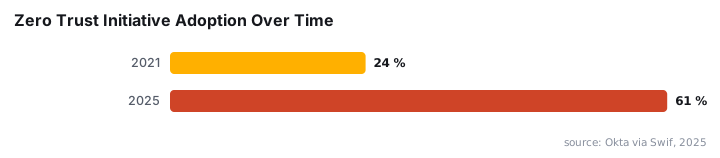
Okta reports that 61% of organizations worldwide have launched a Zero Trust initiative, up from 24% in 2021. This rapid adoption reflects both increased threat awareness and regulatory pressure.
Key Takeaways
- Zero Trust is a security framework requiring continuous verification of users, devices, and transactions rather than trusting network location
- Organizations save an average of $1.76 million per breach with mature Zero Trust deployments
- The model operates on three principles: verify explicitly, enforce least privilege, and assume breach
- Implementation involves identity management, device assessment, micro-segmentation, and policy-driven access control
- Zero Trust supports remote work, cloud infrastructure, and regulatory compliance through granular visibility and logging
- Adoption typically occurs incrementally, starting with critical assets and expanding over time
Frequently asked questions
Is Zero Trust a product I can buy?+
No. Zero Trust is a security framework and set of principles, not a single product. Implementation typically requires multiple integrated technologies including identity providers, endpoint detection tools, network segmentation solutions, and policy engines working together under unified policies.
Does Zero Trust replace firewalls and VPNs?+
Zero Trust does not necessarily eliminate firewalls but changes their role. Traditional VPNs that grant broad network access become less relevant. Instead, organizations use application-level proxies and identity-aware access controls that verify every request regardless of network location.
How long does Zero Trust implementation take?+
Implementation timelines vary significantly based on organizational size and complexity. Most enterprises adopt Zero Trust incrementally over months or years, starting with critical assets and gradually expanding coverage. A phased approach reduces disruption while building toward comprehensive protection.
Can Zero Trust protect legacy systems?+
Yes. Organizations can place Zero Trust proxies and gateways in front of legacy applications to add modern authentication and authorization without modifying the underlying systems. This approach enables security improvements for applications that predate current security standards.