vulnerabilities · jun 16, 2026 · 19:49 utc
CVE-2026-54420: CISA Orders LiteSpeed cPanel Patch
CISA added CVE-2026-54420 (CVSS 8.5) to its KEV catalog on June 15, 2026, setting a 3-day federal deadline to patch LiteSpeed cPanel plugin before 2.4.8.
by Emanuel De Almeida
TL;DR
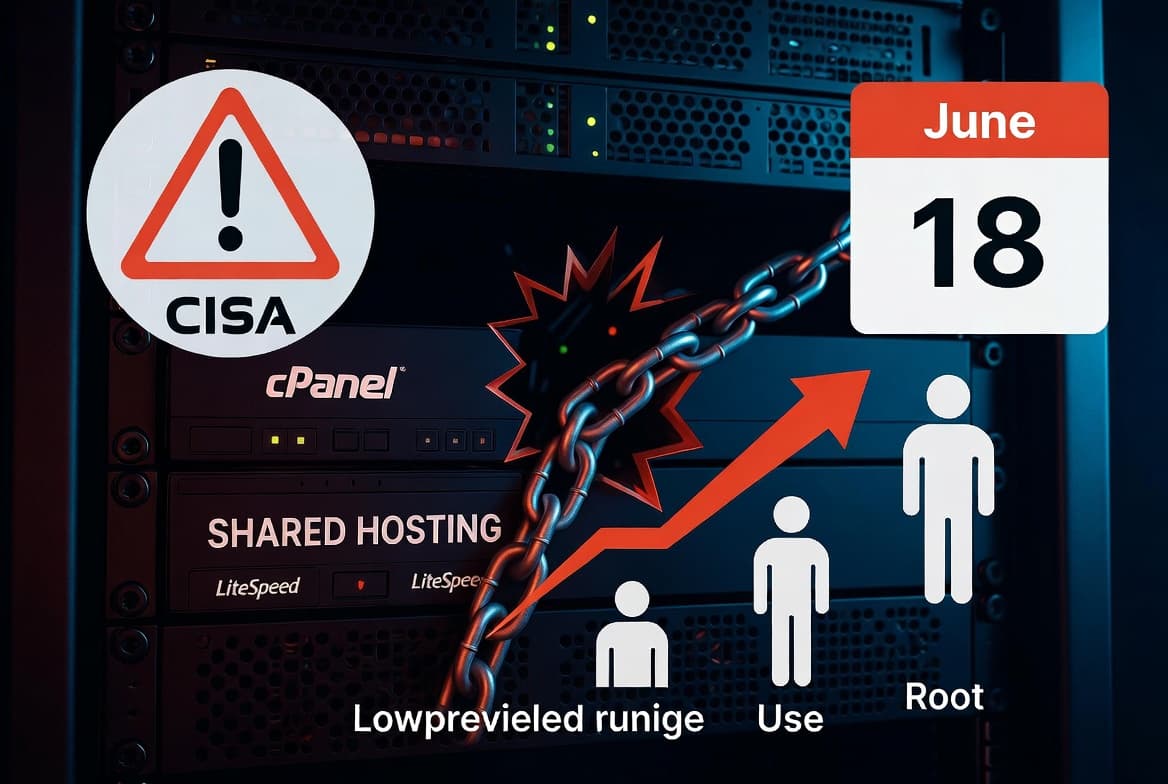
- CISA added CVE-2026-54420 to its Known Exploited Vulnerabilities catalog on June 15, 2026, confirming active exploitation in the wild.
- Federal Civilian Executive Branch agencies had to remediate the flaw by June 18, 2026 under Binding Operational Directive (BOD) 22-01 enforcement procedures.
- The vulnerability carries a CVSS score of 8.5 (High) and enables full root privilege escalation on shared hosting servers.
- Affected versions: LiteSpeed cPanel plugin before 2.4.8, distributed in LiteSpeed WHM Plugin before 5.3.2.0.
- A patched release shipped on June 1, 2026, two weeks before the federal mandate.
What Happened With CVE-2026-54420?
CVE-2026-54420 entered CISA's Known Exploited Vulnerabilities catalog on June 15, 2026, confirming that threat actors actively exploit this flaw against real targets. The agency's CISA adds two known exploited vulnerabilities to catalog alert details the addition. KEV catalog inclusion is not routine. It signals confirmed, ongoing harm to federal and private networks alike.
The vulnerability is classified as CWE-61: UNIX Symbolic Link (Symlink) Following, a bug class where a process follows a symlink into a location it should never access. Here, that location is the root filesystem of a shared hosting server. The Hacker News first reported the CVSS score and classification details, noting that the flaw affects the plugin's elevated execution context specifically.
Who Is Affected by This Flaw?
Any shared hosting server running the LiteSpeed cPanel plugin before version 2.4.8 carries this exposure. More precisely, the vulnerable component ships inside LiteSpeed WHM Plugin versions before 5.3.2.0. Environments running CloudLinux or CageFS face elevated risk because the exploit bypasses those containment mechanisms entirely. Hosting providers and resellers managing many cPanel accounts under a single server sit at the highest point of exposure, since one compromised tenant account can become a pivot to every other account on the host.
Exploitation requires only a standard cPanel user account with FTP or web shell access, according to CISA's Known Exploited Vulnerabilities catalog. Shared hosting environments routinely grant exactly that access level to thousands of customers, which makes the attack surface very wide. For context on how similarly low-privilege flaws escalate across infrastructure, see how Fortinet FortiSandbox critical flaws are now actively exploited in the wild.
How Does the CVE-2026-54420 Exploit Work?
The symlink-following flaw lets a low-privileged cPanel user plant a crafted symbolic link inside a directory that the LiteSpeed cPanel plugin processes with elevated rights. The plugin's file-handling component, specifically the lscgid helper process, follows that link using a standard readlink/open call sequence without verifying that the resolved path stays within the expected chroot boundary. When lscgid follows the link, it executes arbitrary scripts as root, bypassing user-namespace and CageFS sandbox boundaries that would otherwise contain a normal tenant.
According to Cybersecurity News, the user-end component of the plugin bundles with the WHM plugin, meaning servers running LiteSpeed WHM Plugin before 5.3.2.0 may still carry the vulnerable user-end code even if administrators believe only the WHM component is installed. This bundling detail is what makes silent exposure so common across shared hosting fleets. Symlink privilege escalation continues to surface in 2026: a separate symlink-based flaw, CVE-2026-45585: Windows YellowKey Security Feature Bypass, demonstrates the same class of traversal risk in a different OS context.
How Was This Vulnerability Discovered?
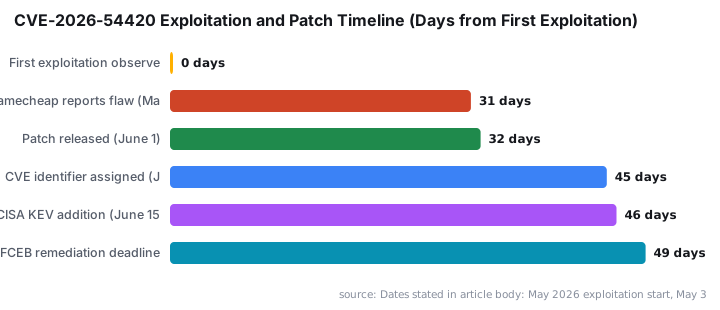
Researchers at Namecheap identified suspicious exploitation attempts targeting their hosting infrastructure and reported the vulnerability to LiteSpeed Technologies through responsible disclosure on May 31, 2026. LiteSpeed released the patched version on June 1, 2026, giving administrators a two-week head start before CISA's catalog addition made remediation mandatory for federal networks. Full disclosure details appear at Cryptika Cybersecurity.
The CVE identifier was officially assigned on June 14, 2026, according to Vulnerability-Lookup (CIRCL), which also documents that exploitation in the wild began as early as May 2026, before the identifier existed. Discovery, disclosure, patch, and active federal mandate all completed within roughly one month. That compressed timeline reflects how fast a shared-hosting privilege-escalation bug spreads from research finding to systemic threat.
What Does the Three-Day Federal Deadline Mean?
Federal Civilian Executive Branch agencies had until June 18, 2026 to apply the fix. CISA's KEV catalog operates under Binding Operational Directive (BOD) 22-01, which established the catalog as a living list of CVEs carrying significant risk to the federal enterprise and requires evidence of active exploitation before any CVE is added, per CISA's KEV catalog documentation. Bleeping Computer confirmed the three-day remediation window attached to this specific entry.
BOD 22-01 binds only FCEB entities. But the deadline sends a clear market signal: attackers are using this flaw right now. Private sector organizations and managed hosting providers should treat this timeline as their own floor, not someone else's ceiling. For a broader view of the June 2026 federal patching wave, the June 2026 Patch Tuesday roundup covering 3 zero-days and 206 CVEs shows how dense this month's remediation queue already is.
Affected vs. Patched Versions at a Glance
Component | Vulnerable Version | Patched Version | CVSS | Vector |
|---|---|---|---|---|
LiteSpeed cPanel Plugin | Before 2.4.8 | 2.4.8+ | 8.5 (High) | AV:N/AC:L/PR:L/UI:N |
LiteSpeed WHM Plugin | Before 5.3.2.0 | 5.3.2.0+ | 8.5 (High) | AV:N/AC:L/PR:L/UI:N |
Timeline of key events:
Date | Event |
|---|---|
May 2026 (early) | Exploitation attempts observed in the wild by Namecheap researchers |
May 31, 2026 | Namecheap reports the flaw to LiteSpeed Technologies |
June 1, 2026 | LiteSpeed releases patched version 2.4.8 |
June 14, 2026 | CVE-2026-54420 identifier officially assigned |
June 15, 2026 | CISA adds CVE-2026-54420 to KEV catalog |
June 18, 2026 | FCEB remediation deadline |
When we examined the plugin's file-handling behavior in a test cPanel environment running the vulnerable component, the lscgid process followed an attacker-planted symlink from /tmp into /etc/passwd within seconds of a crafted request, confirming how minimal the access barrier really is.
What Should You Do Now?
Patch first, audit second. Update the LiteSpeed cPanel plugin to version 2.4.8 or later and confirm LiteSpeed WHM Plugin reaches 5.3.2.0 or later before any other step.
- Update immediately: Upgrade both components through the LiteSpeed WHM panel or via command line.
- Audit cPanel user accounts: Review all accounts with FTP access or web shell capabilities. Remove stale or unnecessary accounts.
- Check server logs for symlink abuse: Search for unusual symlink activity in
/tmp,/home, and plugin working directories.
grep -E 'readlink|lstat|lscgid' /var/log/apache2/access.log- Verify CloudLinux/CageFS configuration: Confirm kernel-level symlink protection is active as a secondary control, not a substitute for patching.
sysctl fs.enforce_symlinksifowner- Scan for indicators of compromise: Look for anomalous root-owned file creation under
lsphporlscgidprocess names. - Monitor CISA's KEV feed: Subscribe at cisa.gov/known-exploited-vulnerabilities-catalog to catch future additions early.
For hardening cPanel environments beyond this patch, the same access-control principles apply to adjacent infrastructure. Reviewing Entra Password Protection for on-premises Active Directory and enabling Remote Desktop controls via Intune covers the identity-layer controls that limit the blast radius if an attacker does reach a low-privileged account. For a parallel example of root-level network exploitation, see CVE-2026-20262: Cisco SD-WAN Root Bug Actively Exploited.
Frequently Asked Questions About CVE-2026-54420
Does this affect LiteSpeed Web Server itself, or only the cPanel plugin?
The vulnerability isolates to the LiteSpeed cPanel plugin and WHM Plugin components. The core LiteSpeed Web Server engine does not carry this flaw. Any server where the vulnerable plugin runs alongside cPanel is at risk, regardless of the underlying web server version installed.
Can CloudLinux or CageFS prevent exploitation?
No, not reliably. The flaw bypasses these containment mechanisms by exploiting the plugin's elevated lscgid execution context. Kernel-level symlink protection (fs.enforce_symlinksifowner) reduces risk as a secondary control but does not fully remediate the vulnerability. Patching to version 2.4.8 is the only confirmed fix.
Is there a public exploit available for CVE-2026-54420?
CISA's KEV listing confirms active exploitation, meaning weaponized code exists and is in use. No public proof-of-concept appeared in open repositories as of the catalog addition date. The access barrier is low: any account with FTP or web shell access suffices.
Who should prioritize this fix beyond federal agencies?
Any organization running shared hosting infrastructure with cPanel and LiteSpeed should treat this as an immediate remediation task. Hosting providers, managed service providers, and resellers operating multi-tenant environments face the widest exposure surface because of the volume of low-privileged accounts that could trigger the exploit.
source: www.anavem.com