SCADA Explained: Definition, How It Works & Security Risks
SCADA powers 16 critical infrastructure sectors. Learn its 4 core components, how data flows from sensor to control room, and the security risks IT teams must address.
by Emanuel De Almeida
TL;DR
- SCADA (Supervisory Control and Data Acquisition) collects real-time sensor data from field devices and lets operators remotely control industrial equipment from a central location.
- Every SCADA deployment has four core building blocks: the HMI, SCADA server, RTUs/PLCs, and communication infrastructure.
- SCADA spans power grids, water utilities, pipelines, manufacturing plants, and transport networks - anywhere distributed assets need centralized oversight.
- Legacy protocols like
Modbushave no native authentication or encryption, making IT-OT convergence the primary attack surface. - According to IBM X-Force, OT-related incidents cost organizations an average of USD 4.56 million - slightly above the global breach average.
SCADA systems are the operational backbone of critical infrastructure. Power grids, water treatment plants, and oil pipelines all depend on SCADA to collect sensor data and translate it into real-time control decisions. Understanding SCADA is no longer optional for IT professionals who share networks with these systems - the attack surface is growing fast.
What is SCADA?
SCADA is a supervisory architecture that sits above field-level automation. It does not replace the local controllers managing individual machines. Instead, it aggregates their data, presents a unified operational picture, and provides a channel for high-level commands. Think of it as the central nervous system of an industrial operation - gathering sensory input from across a facility and coordinating responses from a single control room.
SCADA has been powering critical infrastructure for decades. Power grids, water treatment plants, oil pipelines, and railway networks all depend on it. As industrial digitization accelerates and cyber threats targeting operational technology (OT) intensify, IT professionals who share networks with these systems need a clear picture of how SCADA works and where it breaks.
How does SCADA work?
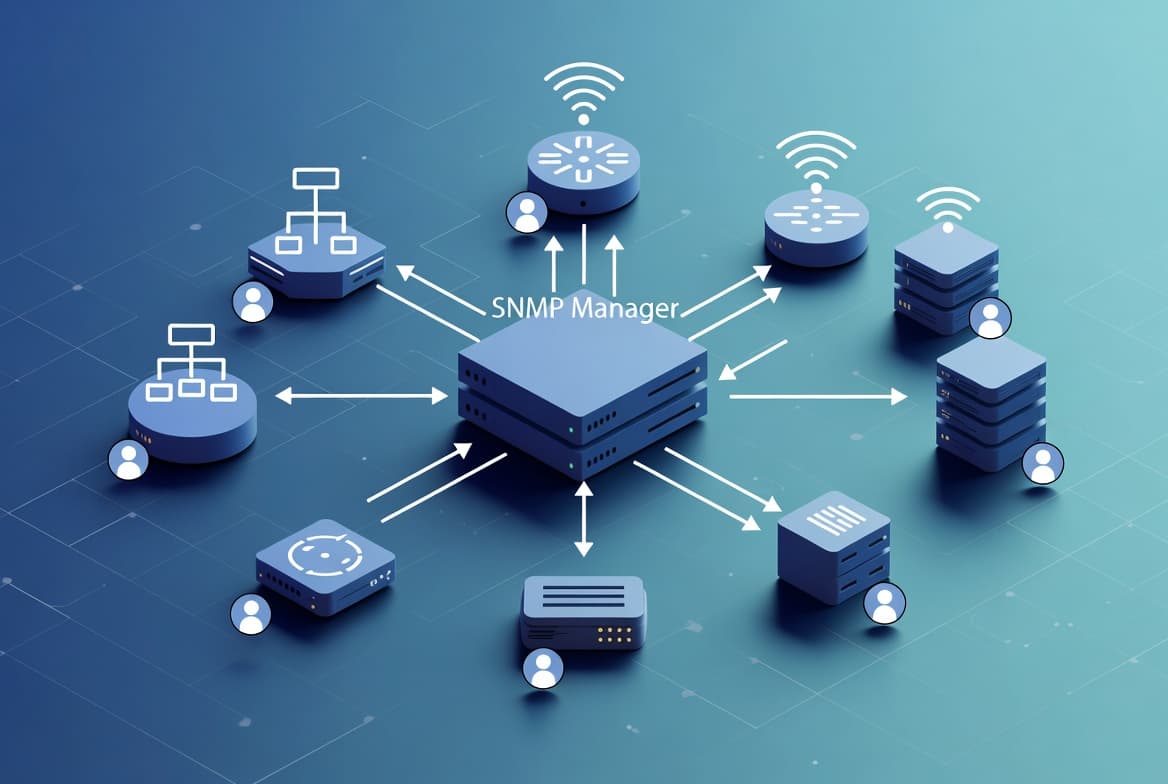
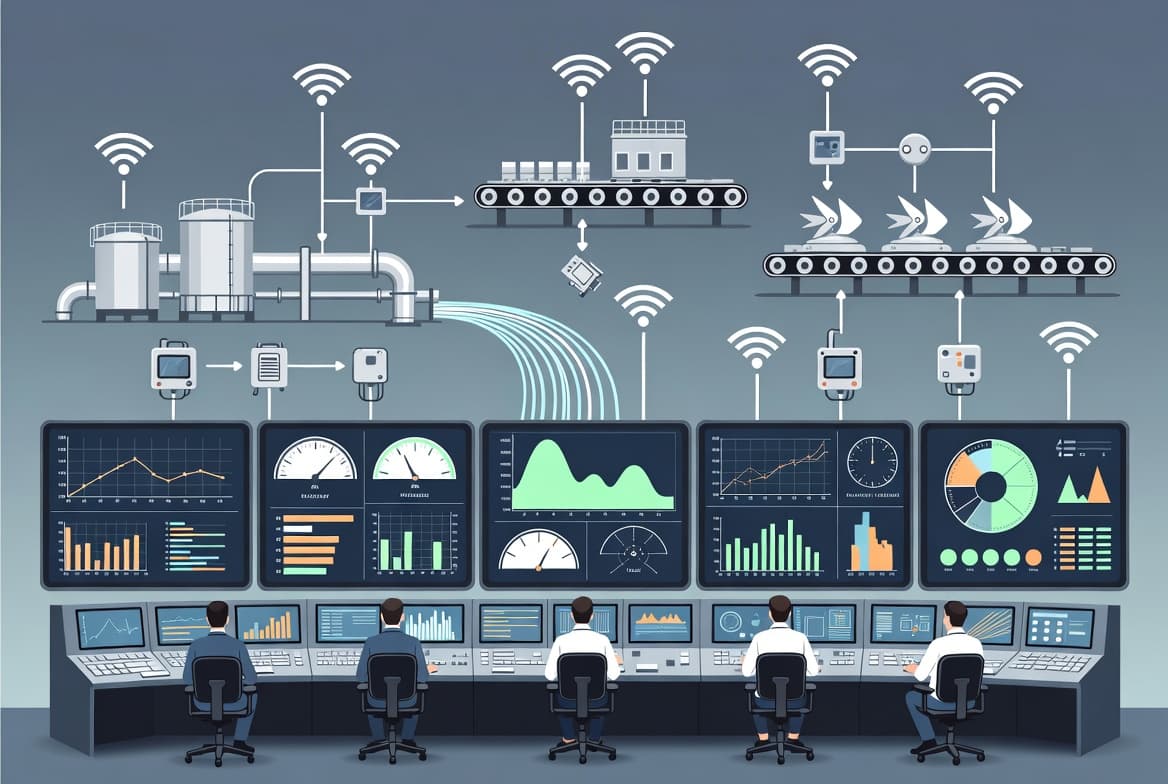
SCADA operates through a layered, hierarchical flow that moves data from physical sensors all the way up to enterprise dashboards - and sends control decisions back down. Each layer has a distinct role. Failures at any layer affect the whole chain.
Here is the data flow in sequence:
- Data collection: Field devices - RTUs (Remote Terminal Units) and PLCs - poll sensors measuring temperature, pressure, flow rate, and equipment status. They digitize analog signals and handle basic local control.
- Data transmission: Collected data travels over serial links, Ethernet, wireless, or specialized industrial protocols such as
Modbus,DNP3, orIEC 61850to reach the central SCADA server. - Data processing: The SCADA server validates incoming data, applies scaling, checks alarm thresholds, and stores readings in a historian database. Advanced deployments add analytics for predictive maintenance.
- Visualization and control: Operators use HMIs - graphical screens showing live process graphics, trends, and alarm panels - to watch the operation and issue commands like opening a valve or adjusting a setpoint.
- Alarm management: The system compares every parameter against predefined limits continuously. Breaches trigger alarms, notifications via email or SMS, and sometimes automated emergency shutdowns.
Modern SCADA systems also integrate upward with MES (Manufacturing Execution Systems) and ERP platforms, linking shop-floor data to business reporting.
What are the main components of a SCADA system?
Four building blocks define every SCADA deployment, regardless of vendor or industry.
- HMI (Human Machine Interface): The operator-facing screens that display process graphics, alarms, and historical trends. A well-designed HMI reduces operator error under pressure.
- Supervisory computer / SCADA server: The central host that aggregates data, runs alarm logic, stores history, and serves the HMI clients. This is the component most exposed to IT-side network threats.
- RTUs and PLCs: The field-level hardware that physically connects to sensors and actuators. RTUs are generally used for geographically remote sites; PLCs are common inside plants. Both execute local control logic even if the SCADA server goes offline.
- Communication infrastructure: The networks and protocols linking field devices to the server. This spans everything from copper serial lines in legacy plants to fiber Ethernet and cellular in modern deployments.
Where is SCADA used?
SCADA is not limited to one industry. Its ability to aggregate data from geographically distributed assets makes it valuable wherever operators cannot physically visit every piece of equipment.
- Power generation and distribution: Utilities use SCADA to remotely switch circuit breakers, monitor transformer temperatures, and balance grid loads. During large-scale weather events, SCADA is the primary tool for coordinating systematic load restoration.
- Water and wastewater: Municipal systems monitor reservoir levels, control pumping stations, and automate chemical dosing based on real-time water quality readings. According to Redbot Security (citing EPA Office of Inspector General), more than 70% of U.S. water systems were out of compliance with cybersecurity requirements, even as real-world attacks forced utilities to revert to manual operations.
- Oil and gas: Pipeline operators monitor pressure, flow rates, and leak detection across thousands of miles. Refineries use SCADA to manage distillation processes within tight safety limits.
- Manufacturing: Chemical plants, food processors, and steel mills use SCADA to run batch processes, enforce product recipes, and log quality data for compliance. IBM's 2026 X-Force Threat Intelligence Index found manufacturing accounted for 27.7% of cybersecurity incidents - the most targeted industry for the fifth consecutive year.
- Transportation: Traffic management centers and railway operators use SCADA-derived architectures to control signals, monitor infrastructure, and manage ventilation in tunnels.
SCADA vs DCS vs PLC - what is the difference?
These three terms overlap and are often confused. The table below separates them by scope and typical use.
System | Scope | Typical use case | Control style |
|---|---|---|---|
PLC | Single machine or process unit | Conveyor, press, pump station | Local, deterministic loop control |
DCS (Distributed Control System) | Single plant or facility | Refinery, chemical plant | Tight, process-integrated control |
SCADA | Multi-site or geographically spread assets | Pipeline network, power grid, water utility | Supervisory - monitors and commands, does not run tight loops |
The practical rule: PLCs control individual machines, DCS controls a whole plant tightly, and SCADA supervises across many sites or systems. In practice these layers often coexist - a SCADA system may sit above a DCS, which in turn commands dozens of PLCs.
What are the biggest SCADA security challenges?
Legacy equipment is the first problem. Many SCADA components were installed before cybersecurity was a design consideration. Industrial protocols like Modbus carry no native authentication or encryption. Patching is risky because maintenance windows are rare, and vendors sometimes do not produce patches at all.
The second problem is IT-OT convergence. Connecting SCADA networks to corporate IT for reporting or remote access opens pathways that never existed in air-gapped deployments. The Stuxnet attack in 2010 and the Ukraine power grid incident in 2015 both demonstrated that those pathways can be exploited with serious physical consequences.
During assessments of HMI configurations in operational plants, we have repeatedly found default credentials still active on RTUs installed within the past five years - not just on decade-old hardware. That pattern mirrors what IBM X-Force reported: 49% of the 670 OT-relevant vulnerabilities disclosed in H1 2025 carried a CVSS rating of Critical or High, and 21% of Critical findings already had public exploit code available.
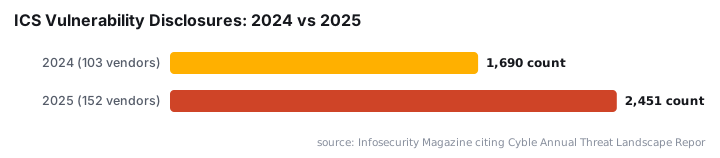
The scale of exposure is growing quickly. According to Infosecurity Magazine (citing Cyble), ICS vulnerability disclosures nearly doubled year-over-year - 2,451 vulnerabilities across 152 vendors in 2025, up from 1,690 across 103 vendors in 2024. Industrial Cyber reported over 12,000 cybersecurity incidents targeting industrial control systems in 2024 alone, with 80% of manufacturers reporting a surge in incidents after integrating enterprise IT resources into plant networks.
State-aligned threat actors are accelerating their focus on this space. Industrial Cyber also recorded a 49% increase in attacks by state-aligned adversaries on energy, transport, and water sectors during 2024, with threat actors using ICS-aware toolkits and conducting long-term reconnaissance inside OT networks.
Key security controls for IT and OT teams:
- Network segmentation: Treat the SCADA network as a separate zone. Use industrial demilitarized zones (iDMZ) to broker traffic between IT and OT rather than allowing direct connections.
- Inventory and visibility: You cannot protect assets you cannot see. Passive OT asset discovery tools avoid the risk of active scanning disrupting sensitive field devices.
- Authentication hardening: Change default credentials on RTUs, PLCs, and HMI servers. Apply role-based access so operators can only act within their defined scope.
- Patch management strategy: Prioritize patches based on exposure. Devices with network interfaces facing the IT side carry higher risk than air-gapped field devices.
- Incident response planning: OT incidents may require coordinating with safety engineers and regulators, not just IT teams. Pre-plan escalation paths before an event occurs.
The same credential-hardening discipline that applies to endpoint management on Windows fleets - such as locking Windows logon to the current user via Intune - reflects the kind of access-control thinking OT teams need to apply to HMI and RTU accounts. Lateral movement patterns seen in ransomware groups that deploy multi-EDR killer suites are now appearing in ICS environments too, where security tooling coverage is far thinner. Similarly, credential exposure events like the FortiBleed leak of 73,932 Fortinet VPN credentials are a direct reminder that remote-access infrastructure used to reach SCADA systems from corporate networks carries its own risk.
What should you remember about SCADA?
- SCADA is a supervisory architecture that collects sensor data from field devices, presents it through operator interfaces, and enables remote control of industrial equipment.
- Its four core components are the HMI, SCADA server, RTUs/PLCs, and communication infrastructure - each layer is a potential point of failure or attack.
- SCADA spans industries from power and water to oil, gas, manufacturing, and transport - anywhere geographically distributed assets need centralized oversight.
- Security risk grows with connectivity. Legacy protocols lack authentication, and IT-OT integration introduces new attack paths that require deliberate architectural controls.
- SCADA, DCS, and PLCs are complementary layers - understanding the distinction matters when designing security zones or troubleshooting integration problems.
- Redbot Security (citing Dragos 2025 OT Year in Review) reported nearly 1,700 ransomware attacks against industrial organizations in 2024, an 87% increase over the prior year - a number that frames the urgency clearly.
Frequently asked questions
What does SCADA stand for?+
SCADA stands for Supervisory Control and Data Acquisition. The name reflects its two core jobs: acquiring real-time data from field sensors and giving operators supervisory control over the equipment generating that data, all from a central location.
What is the difference between SCADA and a PLC?+
A PLC (Programmable Logic Controller) is a field device that executes control logic locally - closing a valve, starting a motor. SCADA is the wider supervisory layer that collects data from many PLCs, presents it to operators, and sends high-level commands back down.
Is SCADA considered IT or OT?+
SCADA sits firmly in Operational Technology (OT), because it directly interacts with physical processes and equipment. However, modern SCADA systems increasingly connect to corporate IT networks for reporting and analytics, which is exactly where many security risks originate.
What are the biggest security risks for SCADA systems?+
The main risks are network exposure from IT-OT integration, legacy software that cannot be patched, weak or default authentication on field devices, and the use of older industrial protocols that were designed without encryption or authentication in mind.