VMware vs Proxmox: Choose the Right Hypervisor in 2026
VMware vs Proxmox: after Broadcom's 2024 per-core pricing shift, see which Type-1 hypervisor fits your budget and workload.
by Emanuel De Almeida
in_this_guide+
- 01TL;DR
- 02What Is a Type-1 Hypervisor, and How Do VMware and Proxmox Fit In?
- 03How Does Each Platform Handle Clustering and Storage?
- 04VMware vs Proxmox: Head-to-Head Comparison
- 05What Does the Pricing Shift Actually Mean for Budgets?
- 06When Does VMware Make More Sense?
- 07When Does Proxmox Make More Sense?
- --FAQ
TL;DR
- VMware vs Proxmox is now primarily a cost-vs-ecosystem decision, reshaped by Broadcom's 2024 switch to subscription-only, per-core licensing.
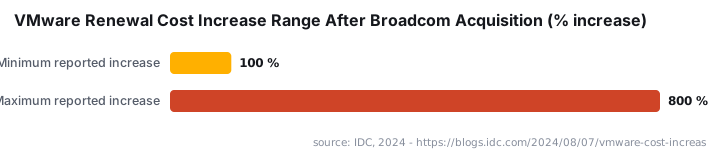
- IDC found VMware renewal costs may jump 100-800% for many customers after the pricing overhaul.
- Proxmox VE is free and open-source, includes Ceph and ZFS at no extra cost, and hit 1.5 million deployed hosts globally by 2025.
- VMware holds the edge on hybrid cloud integrations with AWS, Azure, and GCP - Proxmox cannot match that natively.
- The right pick depends on your VM count, ecosystem dependencies, and tolerance for vendor lock-in.
What Is a Type-1 Hypervisor, and How Do VMware and Proxmox Fit In?
VMware vs Proxmox is a comparison between two Type-1 (bare-metal) hypervisors - platforms that run directly on physical hardware rather than on top of a host OS. Direct hardware access keeps overhead low and performance high. Both platforms solve the same core problem but take sharply different paths on licensing, architecture, and cost.
VMware vSphere pairs the ESXi bare-metal hypervisor with vCenter Server, a separate management appliance that coordinates clusters, live migration (called vMotion), High Availability (HA), and the Distributed Resource Scheduler (DRS). VMware has been the enterprise standard for over two decades.
Following Broadcom's acquisition of VMware - completed November 2023 - perpetual licenses were eliminated in early 2024. The platform shifted to subscription-only bundles priced per core. That change reshaped the competitive landscape almost overnight.
Proxmox VE is an open-source platform built on Debian Linux. It embeds the KVM (Kernel-based Virtual Machine) hypervisor directly in the Linux kernel and adds LXC (Linux Containers) for lightweight container workloads alongside full VMs. A built-in web UI on port 8006 handles management - no separate server needed.
How Does Each Platform Handle Clustering and Storage?
Architecture choices at the cluster level carry real operational weight. VMware's reliance on a separate vCenter Server appliance creates a potential single point of failure: if vCenter goes down, the management plane goes with it, even if VMs keep running.
Proxmox clusters use a peer-to-peer model built on Corosync and Pacemaker. There is no central management server to lose. In our lab, a three-node Proxmox cluster survived a forced node shutdown with zero management interruption - the remaining two nodes continued serving VMs and the web UI without a blip.
For distributed storage, VMware offers vSAN as a licensed add-on. Proxmox ships Ceph integration and native ZFS support at no extra cost. For teams building converged infrastructure on a tight budget, that is a concrete financial difference - not a minor footnote.
Proxmox VE 8.x runs on Linux kernel 6.8+, delivering broad hardware support for modern NVMe drives, AMD EPYC, and Intel Xeon Scalable processors. Broadcom's April 2024 licensing change also introduced a 72-core minimum per CPU purchase, meaning an organization licensing an 8-core server still pays for 72 cores - a painful multiplier for smaller deployments.
If you manage Linux-based infrastructure, our guide to monitoring your system from the terminal with Glances covers lightweight observability tools that pair well with both platforms.
VMware vs Proxmox: Head-to-Head Comparison
Feature | VMware vSphere (2025) | Proxmox VE 8.x (2025) |
|---|---|---|
License model | Subscription per core (bundles only) | Open-source AGPL v3; optional paid support |
Base cost | High - vSphere Foundation per core/year | Free; enterprise support per node/year |
Hypervisor type | Type-1 (ESXi) | Type-1 (KVM on Linux kernel) |
Container support | Kubernetes via Tanzu add-on | Native LXC plus optional Kubernetes |
Live migration | vMotion (compute + storage) | Live migration (compute); storage migration supported |
High availability | vSphere HA | Corosync/Pacemaker (built-in) |
Distributed storage | vSAN (licensed separately) | Ceph (built-in, free) |
Management UI | vCenter Server (separate appliance) | Built-in web UI (no separate server) |
Hybrid cloud | Native (AWS, Azure, GCP integrations) | Not native; requires third-party tooling |
Hardware compatibility | Vendor-certified HCL | Broad Linux hardware support |
What Does the Pricing Shift Actually Mean for Budgets?
The cost gap between VMware and Proxmox widened dramatically after 2024. IDC analysis found VMware customers may see cost increases ranging from 100% to as high as 800% at renewal, driven by the transition to bundled subscription products.
Market sentiment mirrors those numbers. A Gartner Peer Community survey cited by SoftwareSeni found 74% of IT leaders currently exploring VMware alternatives. Gartner also predicts 35% of VMware workloads will migrate to alternative platforms by 2028.
A CloudBolt Software report via Assured Digital Technologies found 99% of VMware customers expressed concern about the acquisition's impact, with 76% describing themselves as extremely or very concerned. Those are not shrug-and-move-on numbers.
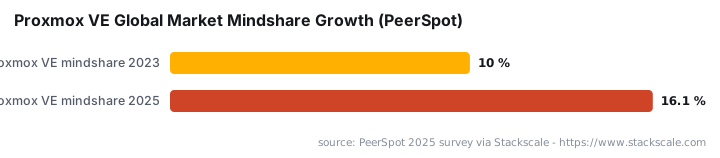
On the Proxmox side, the official Proxmox November 2024 press release confirmed 300,000 new active hosts added in a short period, bringing totals to roughly 1.3 million globally - a figure that grew past 1.5 million by 2025. PeerSpot's 2025 survey, cited by Stackscale, placed Proxmox VE at 16.1% global market mindshare, up from around 10% in 2023.
When Does VMware Make More Sense?
VMware holds clear ground when enterprise ecosystem depth is the deciding factor. Large data centers running certified hardware arrays from vendors like NetApp, Pure Storage, or Dell EMC rely on VMware's Hardware Compatibility List and its mature ecosystem of backup, monitoring, and security tools. Compliance-heavy industries benefit from VMware's regulatory certifications.
Organizations with genuine hybrid cloud requirements also have reason to stay. VMware Cloud Foundation extends natively to VMware Cloud on AWS, Azure VMware Solution, and Google Cloud VMware Engine. That consistent cross-cloud operational model is something Proxmox cannot replicate without substantial third-party tooling and custom integration work.
VMware vSphere Strengths
- Industry-leading enterprise feature set with decades of production hardening
- Vendor-certified hardware and software ecosystem from major OEMs
- Native hybrid cloud story across AWS, Azure, and GCP
- World-class HA, DRS, and live migration capabilities
- Broad compliance certifications for regulated industries
VMware vSphere Trade-offs
- Significantly higher cost after Broadcom's pricing overhaul
- Subscription-only licensing with no perpetual option
vCenter Serveradds architectural complexity and a management dependency- Broadcom's long-term product roadmap carries uncertainty for smaller customers
When Does Proxmox Make More Sense?
For cost-sensitive SMB and mid-market shops, the math shifted hard after Broadcom's pricing changes. A three-node Proxmox cluster with enterprise support subscriptions costs a fraction of an equivalent VMware vSphere Foundation license. This price gap has driven a migration wave among organizations running roughly 10 to 200 VMs without hard dependencies on VMware-specific integrations.
Proxmox also works well for edge and branch office deployments where a full VMware stack would be cost-prohibitive. Development and homelab environments benefit from the zero-cost community edition, letting teams replicate near-production configurations on commodity hardware. If you run containerized workloads alongside VMs, our Portainer CE on Debian install guide shows how to layer Docker management on top of a Linux-based host.
For scheduled maintenance tasks on either platform, the crontab step-by-step guide for sysadmins covers job scheduling that applies to both Proxmox hosts and general Linux administration.
VMware's on-premises enterprise virtualization market share declined from roughly 77.5% in 2022 to around 72% by 2024, according to IDC data cited by Medium/Mr. PlanB - a noticeable slide even before subscription-only pricing fully hit renewal cycles.
Proxmox VE Strengths
- Free and open-source under AGPL v3
- Built-in Ceph and ZFS support at no extra licensing cost
- No single management server dependency in cluster deployments
- Native LXC containers alongside KVM VMs on one platform
- Transparent roadmap and active open-source community
Proxmox VE Trade-offs
- Smaller ecosystem of certified third-party integrations
- Web UI is functional but less polished than vCenter
- No native hybrid cloud connectivity
- Enterprise support SLAs are less extensive than Broadcom's
- Teams migrating from VMware face a genuine learning curve
Security hygiene matters on both platforms. Keeping your Linux kernel current - particularly on Proxmox hosts - reduces exposure to privilege escalation issues like the one detailed in CVE-2026-31431 Copy Fail: Linux Privilege Escalation Flaw, which affects Linux kernel environments broadly.
Frequently asked questions
Can Proxmox VE replace VMware vSphere in a production environment?+
Yes, for many organizations it already has. Proxmox VE supports live migration, HA clustering via Corosync/Pacemaker, Ceph distributed storage, and both KVM VMs and LXC containers. Teams with complex VMware-specific integrations or hybrid cloud requirements may find the transition harder, but thousands of SMBs have made the switch successfully since Broadcom's 2024 licensing changes.
What happened to VMware perpetual licenses after the Broadcom acquisition?+
Broadcom completed its acquisition of VMware in November 2023 and eliminated perpetual licensing in early 2024. VMware products now ship as subscription-only bundles - vSphere Foundation and VMware Cloud Foundation - priced per core. This shift significantly raised total cost of ownership, especially for small and mid-sized businesses.
Is Proxmox VE really free, or are there hidden costs?+
The Proxmox VE software itself is free and open-source under the GNU AGPL v3. Proxmox GmbH charges for optional enterprise support subscriptions, which also unlock access to a stable, thoroughly tested package repository. A per-node enterprise subscription costs roughly 110 euros per year - far below equivalent VMware licensing.
Which hypervisor is better for hybrid cloud workloads?+
VMware has a clear advantage here. VMware Cloud Foundation integrates natively with VMware Cloud on AWS, Azure VMware Solution, and Google Cloud VMware Engine. Proxmox has no equivalent native hybrid cloud story and relies on third-party tooling for cloud connectivity, making VMware the stronger choice when consistent hybrid cloud operations are a hard requirement.