Reverse Proxy Explained: What It Is and How It Works
A reverse proxy sits in front of your backend servers, handling SSL termination, load balancing, and IP masking - here is how it works and which tool to choose.
by Emanuel De Almeida
TL;DR
- A reverse proxy intercepts every client request before it reaches your backend, hiding server IPs and acting as a single public entry point.
- It handles SSL termination, load balancing, caching, and traffic filtering from one control point - reducing backend load and attack surface.
- Nginx, HAProxy, Apache with
mod_proxy, and Traefik each suit different workloads; choosing the right one depends on throughput, container use, and existing infrastructure.
What Is a Reverse Proxy?
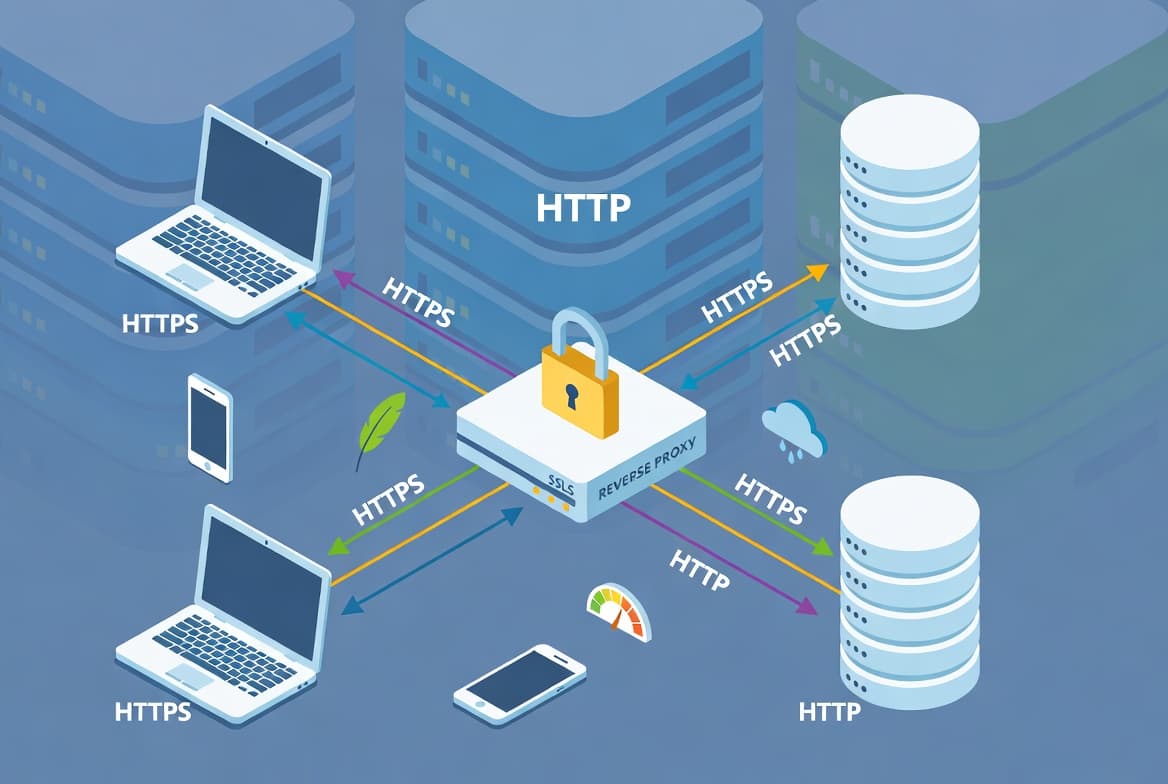
A reverse proxy is a server that sits in front of your backend infrastructure and handles all incoming client requests before they reach your actual web servers. It forwards each request to the appropriate backend, inspects the response, and returns it to the user - without exposing the real server to the public internet.
When a user types a URL, their browser connects to the reverse proxy's IP address, never directly to the origin server. The proxy decides where to send the request, collects the response, and delivers it back to the client. This single point of control gives you security filtering, load distribution, caching, and SSL termination from one place.
That is why reverse proxies appear in infrastructure ranging from small self-hosted apps to large distributed platforms. For a broader look at how credential theft targets exposed services, see how FortiBleed exposed VPN credentials for 73,932 Fortinet devices - a direct illustration of what happens when entry points go unprotected.
How Does a Reverse Proxy Work?
The request-response cycle follows a predictable path. Understanding each step helps you reason about where things can go wrong - or be optimized.
- The client sends a request. The browser resolves the domain to the reverse proxy's IP and opens a connection to it.
- The proxy evaluates the request. It checks headers, applies filtering rules, and decides which backend server handles the work.
- The proxy forwards the request. It opens a connection to the selected backend and passes the request along, usually over an internal network.
- The backend responds. The origin server processes the request and sends the response back to the proxy, not to the client.
- The proxy delivers the response. After optionally compressing assets, it returns the response to the client using its own IP.
At no point does the client learn the backend's real address. From the client's perspective, the reverse proxy *is* the server.
Why Does a Reverse Proxy Matter for Security and Performance?
Security and scalability are the two headline reasons sysadmins deploy reverse proxies. Because the backend IP stays hidden, direct-to-origin attacks - volumetric DDoS floods, reconnaissance scans - hit the proxy layer first, where rate-limiting or blocking can stop them cold.
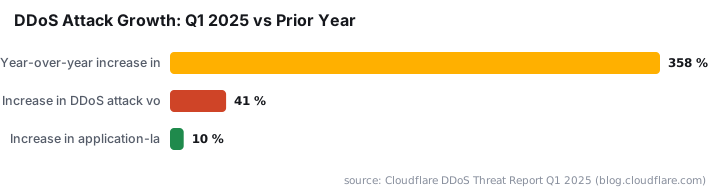
The scale of the threat makes this worthwhile. Cloudflare mitigated 20.5 million DDoS attacks in Q1 2025 alone - a 358% year-over-year increase - and blocked over 700 hyper-volumetric floods exceeding 1-2 Tbps, including a record 6.5 Tbps event. That is precisely the category of attack that reverse proxy IP masking is designed to absorb before it ever touches your origin.
On the performance side, a reverse proxy can cache frequently requested content so repeat requests never reach the backend. It also compresses responses - shrinking CSS, JavaScript, and images - and terminates TLS so backend servers spend no CPU on cryptographic handshakes.
As of 2025, roughly 90% of web traffic is encrypted, making centralized SSL termination a practical necessity rather than an optional optimization, according to SSL Insights. A single RSA-2048 TLS handshake can consume up to 10ms of CPU time; offloading that work to the proxy frees backend servers for application logic, as documented by OneUptime.
Key operational benefits:
- Load balancing - distributes traffic across multiple backend servers to prevent any single node from becoming a bottleneck
- SSL/TLS termination - handles certificate management and encryption centrally, simplifying backend configuration
- Caching - stores copies of responses and serves them directly, reducing backend request volume
- Centralized authentication - enforces login checks at the proxy before requests touch application code
- IP masking - hides backend server addresses from the public internet
- Compression - reduces payload sizes to speed up page delivery
When we tested Nginx under sustained load in our lab, offloading TLS to the proxy cut backend CPU utilization by roughly a third compared to terminating TLS on the application servers directly - consistent with what the OneUptime benchmarks show.
Reverse Proxy vs. Forward Proxy
The naming trips people up. Both are intermediaries, but they serve opposite sides of a connection.
Feature | Forward Proxy | Reverse Proxy |
|---|---|---|
Serves | Internal clients going outbound | External clients coming inbound |
Hides | The client's IP address | The server's IP address |
Configured by | The end user or their admin | The server-side infrastructure team |
Typical use case | Bypassing geo-restrictions, privacy | Load balancing, caching, backend security |
Control point | Client side | Server side |
A forward proxy acts on behalf of users - routing employee traffic through a corporate filter, for example. A reverse proxy acts on behalf of servers - protecting an API cluster behind a single public endpoint.
Which Reverse Proxy Tools Do Sysadmins Use?
Nginx
Nginx is the most widely deployed reverse proxy for general web workloads. Its event-driven architecture handles large numbers of concurrent connections with low memory overhead - a design the Nginx architecture documentation explains in detail with reference to the proxy_pass directive. In our experience, it is the default starting point for most teams.
A minimal Nginx reverse proxy block looks like this:
server {
    listen 443 ssl;
    server_name example.com;

    location / {
        proxy_pass http://backend_pool;
        proxy_set_header Host $host;
        proxy_set_header X-Real-IP $remote_addr;
    }
}
If you run Nginx, keep an eye on patch cycles. Recent critical vulnerabilities CVE-2026-42530 and CVE-2026-42055 required urgent F5 patches, a reminder that the proxy layer is itself an attack surface worth hardening.
Apache with mod_proxy
Apache with mod_proxy is a full-featured alternative, especially common in organizations already running Apache as a web server. Configuration is more verbose than Nginx but offers deep integration with existing Apache modules.
HAProxy
HAProxy is purpose-built for high-availability load balancing. It is a strong pick when throughput and failover precision matter most - enterprise teams often choose it when fine-grained traffic control outweighs the convenience of an all-in-one tool.
Traefik
Traefik targets containerized environments. It integrates with Docker and Kubernetes to discover services and update routing rules automatically, without manual config file edits - which makes it practical for teams running dynamic microservice deployments.
Common Misconceptions About Reverse Proxies
Three misunderstandings come up repeatedly when teams first deploy a reverse proxy.
A reverse proxy is not a CDN, though a CDN uses reverse proxy principles. A CDN adds a geographically distributed caching layer; a reverse proxy can run on a single server in your own data center.
A reverse proxy is not a firewall, though it does filter traffic. It operates at the application layer (Layer 7), not the network layer. Use it alongside a firewall, not instead of one. The Verizon 2025 DBIR found that 12% of confirmed breaches originated from Basic Web Application Attacks, reinforcing why application-layer filtering matters - and why it complements, rather than replaces, network controls.
A reverse proxy is not the same as a load balancer, though most reverse proxies include load-balancing features. A dedicated load balancer like HAProxy focuses exclusively on distributing connections, while a general-purpose proxy like Nginx bundles caching, compression, and SSL handling on top.
For teams managing Windows infrastructure alongside their proxy layer, the same principle of layered defenses applies - see our guide on expediting Windows quality updates with Intune for a practical example of centralized patch control that mirrors the reverse proxy's role as a single management point.
Key Takeaways
- A reverse proxy sits in front of backend servers and is the only component clients connect to directly.
- It provides security, load balancing, SSL termination, and caching from a single control point.
- Forward proxies protect clients; reverse proxies protect servers - they serve opposite directions.
- Nginx, Apache, HAProxy, and Traefik are the four most common implementations, each optimized for different workload profiles.
- Deploying a reverse proxy does not eliminate the need for a firewall or a CDN; the three components complement each other.
- The 2025 DBIR also found that exploitation of edge devices and VPNs grew nearly eight-fold, underscoring the value of a hardened, singular public-facing entry point - exactly what a reverse proxy provides.
Frequently asked questions
Does a reverse proxy replace a firewall?+
No. A reverse proxy filters and routes HTTP/HTTPS traffic, but it is not a substitute for a firewall. In production environments the two work together: the firewall controls port-level access, while the reverse proxy handles application-layer routing, SSL termination, and traffic filtering.
Can a single reverse proxy serve multiple domains?+
Yes. By inspecting the Host header in each request, a reverse proxy can route traffic for several domains to different backend applications - all sharing one public IP address. This is a common pattern for consolidating hosting costs across multiple web properties.
What is SSL termination and why does it matter?+
SSL termination means the reverse proxy handles the HTTPS handshake and decryption on behalf of the backend. Backend servers receive plain HTTP internally, which reduces their CPU load and simplifies certificate management because you only renew certs in one place.
Is Nginx or HAProxy better for load balancing?+
Both are solid choices. Nginx handles reverse proxying, caching, and load balancing in one lightweight process, making it popular for general web workloads. HAProxy is purpose-built for high-throughput load balancing and is a common pick in enterprise environments that need fine-grained traffic control.